


Laser Cladding for Hydraulic Support Columns: Extending Service Life in Mining Equipment
In modern mining operations, hydraulic supports are essential equipment used to stabilize underground structures and ensure safe production. The support columns and piston rods of hydraulic supports operate under high pressure, heavy load, and harsh underground environments, making them highly susceptible to wear and corrosion.
To address these challenges, laser cladding for hydraulic support columns has become an advanced surface modification technology widely used in recent years. By applying laser cladding for hydraulic support columns, manufacturers can significantly enhance the surface hardness, corrosion resistance, and durability of key hydraulic support components.
Compared with traditional electroplating methods, laser cladding for hydraulic support columns provides stronger metallurgical bonding, better coating performance, and improved environmental sustainability.
Why Hydraulic Support Columns Require Surface Reinforcement
Hydraulic supports in coal mines and other underground environments are exposed to multiple damaging factors, including:
- Continuous high-pressure mechanical stress
- Abrasive particles in underground environments
- Corrosive moisture and chemicals
- Friction during repeated piston movement
Over time, these conditions cause surface damage to the support columns and piston rods, leading to decreased sealing performance and reduced service life.
By applying laser cladding for hydraulic support columns, a protective alloy layer can be formed on the surface, effectively improving wear resistance and corrosion protection while maintaining structural strength.
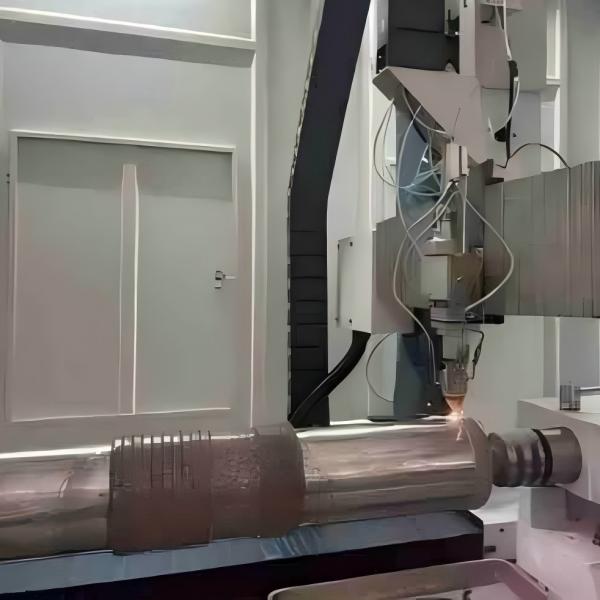
Laser cladding for hydraulic support columns surface reinforcement process
How Laser Cladding Technology Works
Laser cladding for hydraulic support columns uses a high-energy laser beam as the heat source. During the process, alloy powder with high hardness and corrosion resistance is delivered to the working surface of the column or piston rod.
The laser simultaneously melts the alloy powder and the base metal surface, allowing them to react and form a metallurgical bond. After solidification, a dense protective layer is created that provides enhanced mechanical performance.
A typical laser cladding system includes:
- High-power industrial laser generator
- Precision powder feeding system
- High-performance laser cladding head
- Automated control system
These components ensure that the coating layer is uniform, dense, and strongly bonded to the base material.
Advantages of Laser Cladding for Hydraulic Support Columns
Applying laser cladding for hydraulic support columns offers several technical advantages compared with traditional surface treatment technologies.
Strong Metallurgical Bond
The cladding layer forms a metallurgical bond with the base material, ensuring excellent adhesion and durability.
Improved Wear Resistance
The high-hardness alloy layer protects the hydraulic support column surface from abrasion and mechanical friction.
Superior Corrosion Protection
Laser cladding alloys provide excellent resistance to corrosive underground environments.
Low Heat Input and Minimal Deformation
Laser cladding introduces relatively low heat to the base metal, reducing the risk of structural deformation during the repair process.
High Efficiency and Stable Operation
Modern cladding systems equipped with high-power lasers and precision powder feeders ensure stable performance and efficient production.
Laser Cladding Process for Hydraulic Support Repair
The repair and reinforcement process for hydraulic supports generally includes the following stages:
Surface Preparation
The damaged column or piston rod surface is cleaned and prepared to ensure proper bonding of the cladding material.
Laser Cladding Deposition
Wear-resistant alloy powder is delivered to the surface while the laser beam melts both the powder and base material simultaneously.
Controlled Cooling and Finishing
After cladding, the component undergoes controlled cooling and finishing operations to achieve the desired surface quality and dimensional accuracy.
Proper material selection is essential in this process. The composition and ratio of alloy powders must be optimized to produce fine grain structures, smooth weld seams, and long-term protection.
A Sustainable Solution for Hydraulic Support Maintenance
As mining equipment continues to operate under increasingly demanding conditions, surface engineering technologies are becoming essential for equipment maintenance and remanufacturing.
Because of its advantages such as high efficiency, strong metallurgical bonding, environmental friendliness, and excellent performance, laser cladding for hydraulic support columns is rapidly becoming one of the most effective solutions for hydraulic support surface treatment.
At FNS Pipeline Technology Co., Ltd., advanced cladding technologies are used to help industrial customers improve equipment durability, reduce maintenance costs, and extend the service life of critical components.


