



Overlay cladding processing service solutions
We are committed to providing customers with overall overlay cladding solutions through professional material technology, automatic equipment technology and advanced process application technology.
Overlay cladding is a surface engineering process that deposits a corrosion-resistant, wear-resistant, or high-temperature-resistant alloy onto a substrate, typically carbon steel or low-alloy steel. This method combines the structural strength of the base material with the enhanced properties of the cladding material. Here’s a comprehensive overview of overlay cladding processing service solutions:
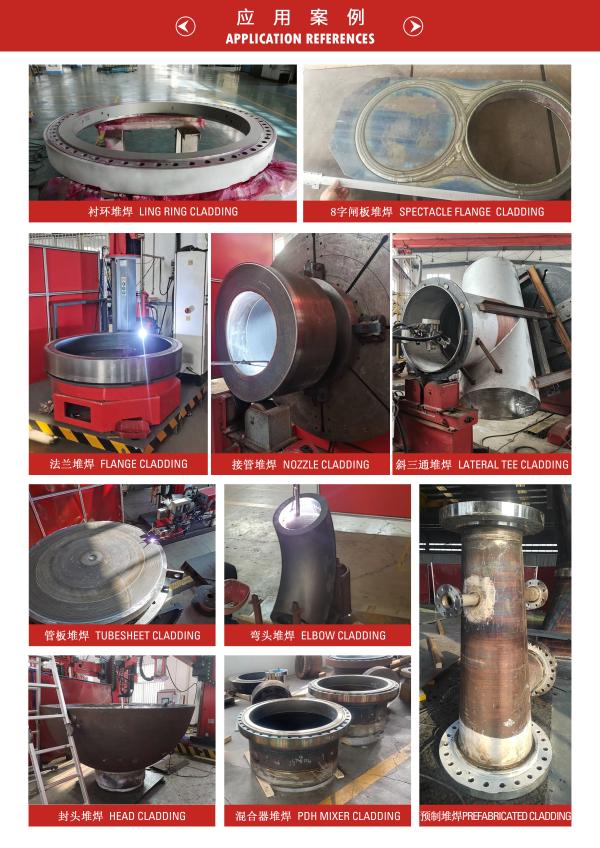
FNS Application References
1. Material Selection
Base Material: Commonly used base materials include:
- Carbon Steel (e.g., ASTM A105, A36)
- Low-Alloy Steel (e.g., ASTM A216, A217)
- Stainless Steel (e.g., 304, 316)
Cladding Material: Depending on the application, various alloys can be used:
Corrosion-Resistant Alloys:
- Alloy 625 (NiCrMo-3)
- Alloy 825 (Incoloy 825)
- Alloy 600 (Inconel 600)
- 316L Stainless Steel
Wear-Resistant Alloys:
- Hardfacing Alloys (e.g., Stellite, Colmonoy)
- Tungsten Carbide (WC)
- High-Temperature Alloys:
- Alloy 617 (Inconel 617)
- Alloy 718 (Inconel 718)
2. Surface Preparation
Cleaning: Degreasing and grit-blasting to remove oxides, scale, and contaminants.
Preheating: Heating the base material to a specified temperature (e.g., 150–200°C) to reduce thermal stress and improve bonding.
3. Cladding Techniques
Gas Tungsten Arc Welding (GTAW): Precise control, suitable for thin layers and intricate geometries.
Plasma Transferred Arc (PTA): High deposition rates, excellent for thick layers and large areas.
Submerged Arc Welding (SAW): High deposition rates, suitable for flat and cylindrical surfaces.
Shielded Metal Arc Welding (SMAW): Versatile, suitable for small and medium-sized components.
Laser Cladding: High precision, minimal heat-affected zone, ideal for complex geometries and thin layers.
4. Process Parameters
Heat Input: Controlled to minimize dilution and ensure proper bonding.
Layer Thickness: Typically 3–5 mm, depending on the application.
Interpass Temperature: Kept below 150–200°C to prevent cracking and maintain metallurgical integrity.
Welding Speed: Adjusted to achieve consistent layer thickness and quality.
5. Post-Weld Heat Treatment (PWHT)
Stress Relief: Stress relieving at 595–620°C (1100–1150°F) to reduce residual stresses.
Solution Annealing: For some alloys, solution annealing at higher temperatures (e.g., 1000–1100°C) followed by rapid cooling to enhance corrosion resistance.
6. Machining and Finishing
Machining: Precision machining to achieve final dimensions and tolerances.
Polishing: Polishing the clad surface to remove any heat-affected zones and improve surface finish.
7. Quality Control and Inspection
Non-Destructive Testing (NDT):
- Ultrasonic Testing (UT)
- Radiographic Testing (RT)
- Liquid Penetrant Testing (PT)
- Magnetic Particle Testing (MT)
Destructive Testing:
- Microstructure Analysis
- Chemical Composition Analysis
- Mechanical Testing (Tensile, Impact, Hardness)
Corrosion Testing:
- ASTM G48 Method A (Ferric Chloride Pitting Test)
- ASTM G28 (Intergranular Corrosion Test)
8. Applications
Oil and Gas: Valves, flanges, and pipeline components in sour service environments.
Chemical Processing: Reactors, heat exchangers, and storage tanks handling corrosive media.
Power Generation: Components in high-temperature and high-pressure environments.
Marine and Offshore: Subsea equipment, offshore platforms, and marine structures.
Mining and Mineral Processing: Wear-resistant linings for chutes, hoppers, and conveyors.
9. Benefits
Cost-Effective: Combines the strength of the base material with the corrosion/ wear resistance of the cladding.
Extended Service Life: Reduces maintenance and replacement costs.
Customizable: Tailored to specific environmental and operational requirements.
Enhanced Performance: Improves overall performance and reliability of critical components.
10. Service Provider Capabilities of FNS
Engineering and Design Support: Customized solutions based on client specifications.
Material Selection and Procurement: Sourcing of high-quality base and cladding materials.
Advanced Welding and Cladding Equipment: State-of-the-art facilities for precise and efficient processing.
Quality Assurance and Certification: Compliance with industry standards and certifications (e.g., ASME, API, ISO).
Post-Processing and Finishing: Comprehensive finishing and inspection services to ensure the highest quality.
By providing these comprehensive overlay cladding processing services, you can ensure that your components and equipment are protected against corrosion, wear, and high-temperature degradation, leading to longer service life and improved performance.


