


Plasma Cladding Repair for Blast Furnace Tuyeres
In blast furnace operations, tuyere failure is one of the most dangerous and costly incidents. Burn-through or sudden rupture of a blast furnace tuyere is rarely accidental—it is usually the result of undetected damage that accumulates over time. Once failure occurs, incandescent coke particles and high-temperature blast furnace gas are violently ejected from the damaged area, producing a sharp, piercing noise and posing serious safety risks.
Early prevention and professional surface reinforcement are critical. Plasma cladding repair for blast furnace tuyeres has proven to be one of the most effective solutions to address wear, erosion, and thermal damage before catastrophic failure occurs.
Why Blast Furnace Tuyeres Fail
Blast furnace tuyeres operate under extreme conditions:
- Continuous high-temperature exposure
- Severe abrasion from hot coke and dust
- Chemical corrosion from high-temperature gas flow
Even under normal operation, long-term service inevitably leads to wear on the inner wall and outer surface of the tuyere. If surface degradation is not detected and treated in time, localized thinning gradually develops, eventually resulting in burn-through or explosion-type failure.
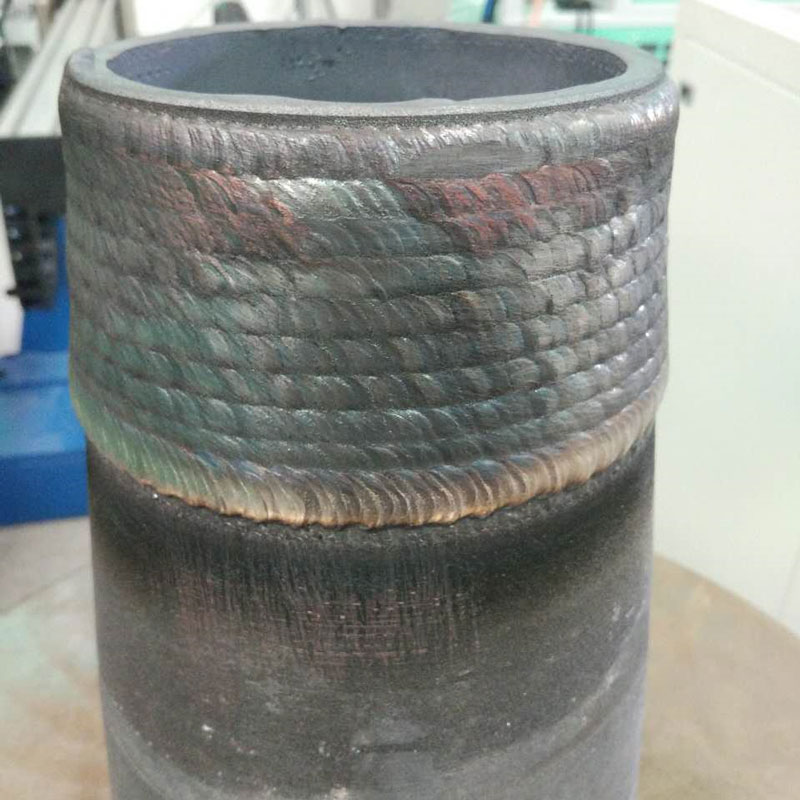
Blast furnace tuyere sleeve surface after plasma cladding repair
Plasma Powder Cladding Solution for Tuyere Protection
To address these challenges, FNS Pipeline Technology Co., Ltd. applies advanced plasma powder cladding technology to reinforce both the inner bore and outer surface of blast furnace tuyere sleeves.
By depositing specially engineered wear-resistant and high-temperature-resistant alloy materials, plasma cladding significantly enhances the base material properties of the tuyere, extending service life and improving operational safety.
How Plasma Powder Cladding Works
Plasma powder cladding equipment uses a transferred plasma arc as a high-energy heat source. During the process:
- Alloy powder and the tuyere substrate are simultaneously melted
- A strong metallurgical bond forms between the cladding layer and the copper base
- After cooling and solidification, a dense, stable wear-resistant and refractory layer is created
Unlike coating or spraying methods, plasma cladding produces a fully bonded layer with excellent resistance to wear, heat, and thermal shock.
Overcoming the Challenge of Copper Tuyere Materials
Blast furnace tuyeres are typically made of pure copper, chosen for its excellent thermal conductivity. However, copper’s high heat dissipation makes plasma processing technically challenging.
Through specialized plasma cladding procedures and custom-designed alloy powders, FNS Pipeline Technology has successfully developed a reliable solution for copper tuyere cladding. The process ensures stable arc control, controlled dilution, and consistent bonding quality—even on highly conductive copper substrates.
Key Benefits of Plasma Cladding for Blast Furnace Tuyeres
- Effective prevention of burn-through failures
- Extended service life of tuyere sleeves
- Improved resistance to wear, erosion, and extreme heat
- Reduced unplanned shutdowns and maintenance costs
- Enhanced operational safety in blast furnace systems
Why Choose FNS Pipeline Technology
With extensive experience in plasma cladding repair for blast furnace components, FNS Pipeline Technology Co., Ltd. provides engineered solutions tailored to harsh metallurgical environments. Our expertise in copper plasma cladding and alloy formulation allows us to deliver consistent, high-performance results for critical blast furnace equipment.


