



304 Stainless Steel Welding Guide: Ensure Quality & Corrosion Resistance | FNS Pipeline
304 stainless steel is a widely used material across various industries, and its welding quality is critical to ensuring structural integrity and corrosion resistance—two core requirements for pipeline and industrial applications. At FNS Pipeline Technology Co., Ltd., we prioritize professional 304 stainless steel welding practices to deliver reliable, long-lasting solutions for our global clients.
Choosing the right welding method is the first step to achieving high-quality 304 stainless steel plate welding. Common methods for 304 stainless steel plate welding include TIG welding (argon arc welding), MIG welding (gas metal arc welding), and arc welding. Our team at FNS Pipeline selects the optimal welding method based on specific project needs, ensuring each weld joint meets the highest performance standards.
Preheating and post-weld heat treatment are indispensable steps in 304 stainless steel weld. Preheating reduces stress and deformation during the 304 stainless steel plate welding process, enhancing the toughness and strength of the weld seam. Post-weld heat treatment further eliminates residual stress, improving the overall performance of the weld joint—key to extending the service life of 304 stainless steel pipeline systems.
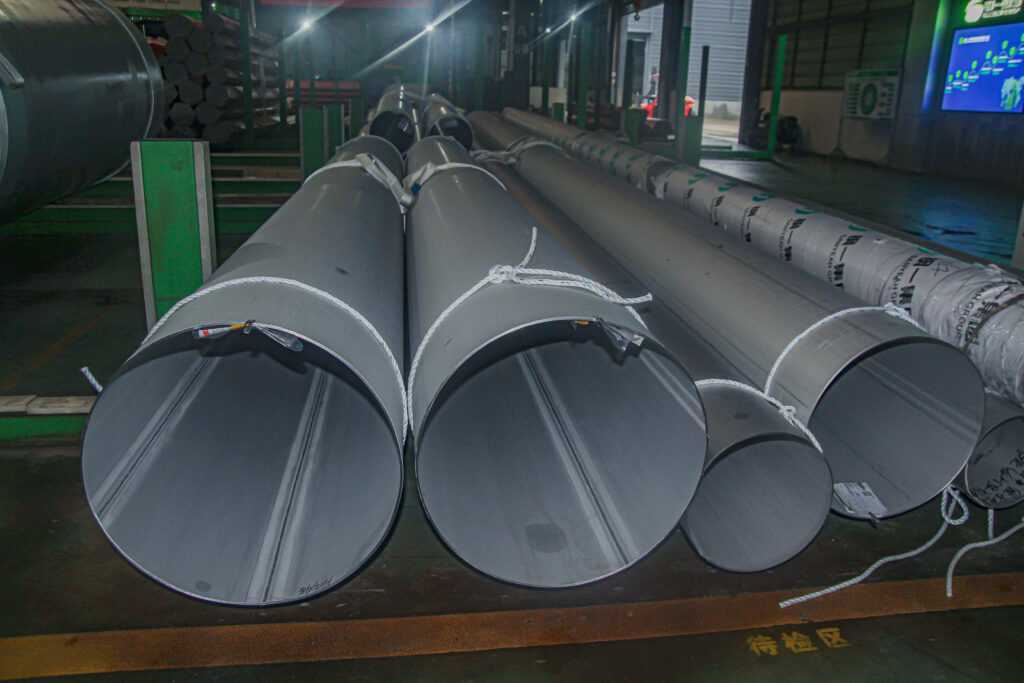
304 Stainless Steel Welding Process – Professional Weld Joint by FNS Pipeline Technology Co., Ltd.
Selecting compatible welding materials is crucial for high-quality 304 stainless steel plate welding. We recommend using welding materials similar to or compatible with the base material to guarantee the weld joint’s strength and corrosion resistance. Common options include 304 stainless steel electrodes and welding wires, which we strictly quality-control at FNS Pipeline to ensure consistency.
Quality control and inspection are integral throughout the 304 stainless steel weld process. Visual inspection assesses weld shape, filling, and geometry to meet the requirements of 304 stainless steel plate welding quality control. Non-destructive testing methods-such as ultrasonic testing, X-ray testing, and magnetic particle testing-help detect hidden defects like pores and cracks, ensuring every weld meets FNS Pipeline’s strict quality criteria.
Optimizing welding parameters is essential for consistent, high-quality 304 stainless steel plate welding. Our technicians carefully adjust welding current, voltage, welding speed, and shielding gas flow to ensure full weld penetration and uniformity for 304 stainless steel plate weld. We also pay close attention to welding torch angle, travel speed, and sequence to achieve smooth, continuous welds.
304 stainless steel is highly sensitive to oxidation and contamination, so preventing these issues is vital during 304 stainless steel plate welding. At FNS Pipeline, we use high-purity argon as the shielding gas to isolate the welding area from air, avoiding oxidation. We also ensure all welding equipment, tools, and workpiece surfaces are clean to prevent contamination.
304 stainless steel post-weld treatment further enhances the performance of its weld joints. This includes removing slag, cleaning the welding area, and performing necessary polishing and surface treatment-steps that ensure the weld joint’s smoothness and corrosion resistance, aligning with FNS Pipeline’s commitment to high-quality 304 stainless steel weld.


