



Internal Bore Plasma Cladding Repair: A Reliable Solution for Valve and Casting Inner Surface Protection
Internal bore plasma cladding repair is a highly effective solution for restoring and strengthening worn or damaged inner surfaces of industrial components. In applications such as valves, valve bodies, and precision castings, inner bores are constantly exposed to aggressive media including liquids, gases, and corrosive substances.
Over time, these conditions lead to corrosion, erosion, and abrasion. By applying internal bore plasma cladding repair, manufacturers can significantly improve the durability and performance of internal surfaces while reducing maintenance costs and downtime.
At FNS Pipeline Technology Co., Ltd., advanced plasma powder cladding systems are designed to deliver stable, high-quality inner bore restoration for a wide range of industrial applications.
Applications of Internal Bore Cladding Technology
Wide Industrial Coverage
Internal bore plasma cladding repair is widely used for:
- Valve inner surfaces and valve bodies
- Hydraulic cylinders and bushings
- Casting inner holes and precision components
- Hot forging dies and mold cavities
- Roller sleeves and cylindrical parts
Repair and Surface Enhancement
This technology is suitable for:
- Repairing worn or damaged inner bores
- Eliminating defects such as scratches, pits, and deformation
- Enhancing wear resistance and corrosion resistance
- Improving performance in high-temperature and harsh environments
For precision molds and critical components, internal bore plasma cladding repair provides a reliable way to restore dimensional accuracy and extend service life.
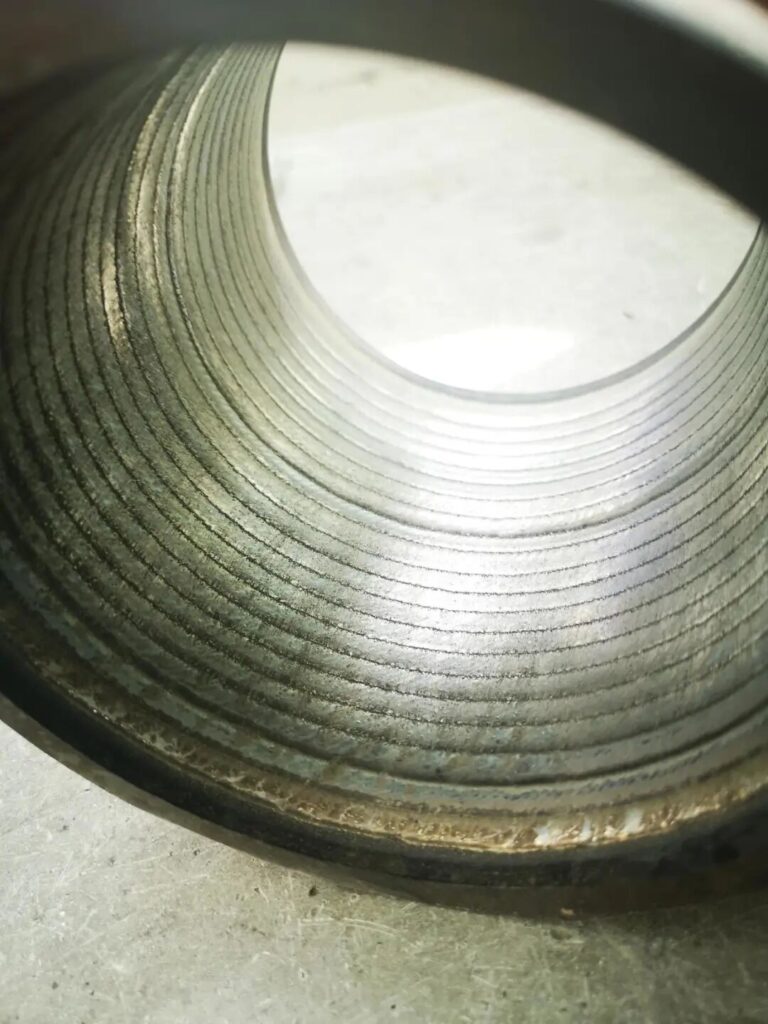
Internal bore plasma cladding repair for valve inner surface
Technical Advantages of Plasma Powder Cladding
Compared with traditional repair methods, internal bore plasma cladding repair offers clear technical benefits:
Metallurgical Bonding
The coating forms a strong metallurgical bond with the base material, ensuring long-term durability without peeling.
High Hardness and Wear Resistance
Cladded layers can reach hardness levels above HRC 60, making them ideal for severe wear conditions.
Low Thermal Distortion
The process generates minimal thermal stress, reducing deformation and maintaining component integrity.
Smooth and Defect-Free Surface
After cladding, the inner surface is:
- Smooth and uniform
- Free from cracks, pores, or delamination
- Suitable for high-precision applications
Efficient and Stable Process
Using alloy powder as filler material ensures:
- Fast deposition speed
- Stable process control
- Consistent coating quality
FNS Internal Bore Cladding Case
FNS has successfully delivered multiple internal bore plasma cladding repair projects for valve manufacturers and heavy industry clients.
Project Highlights
- Component: Valve body inner bore
- Issue: Severe corrosion and wear from chemical media
- Solution: Plasma powder internal bore cladding
Results
- Uniform cladding layer with no cracks or defects
- Hardness above HRC 60
- Improved corrosion and wear resistance
- Extended service life by over 2–3 times
This demonstrates how internal bore plasma cladding repair can deliver both technical reliability and cost savings.
Why Choose Internal Bore Plasma Cladding
For industries requiring high reliability, internal bore plasma cladding repair provides:
- Cost-effective alternative to full component replacement
- Enhanced resistance to corrosion, erosion, and abrasion
- Longer maintenance intervals and reduced downtime
- Consistent quality for critical internal surfaces
With growing demand for performance and sustainability, this technology is becoming a standard solution in modern equipment remanufacturing.
FAQ (Frequently Asked Questions)
1. What is internal bore plasma cladding repair?
Internal bore plasma cladding repair is a process that uses a plasma arc to deposit alloy powder onto the inner surface of components, restoring and strengthening the bore.
2. Which industries use internal bore cladding?
It is widely used in:
- Oil & gas
- Chemical processing
- Power generation
- Machinery manufacturing
3. What materials are used in plasma cladding?
Common materials include:
- Nickel-based alloys
- Cobalt-based alloys
- Iron-based alloys
These materials provide excellent wear and corrosion resistance.
4. Can internal bore cladding prevent cracks and defects?
Yes. The process produces a dense, crack-free coating with strong metallurgical bonding, ensuring long-term performance.
5. How does it compare with traditional repair methods?
Compared to conventional welding or coating methods, plasma cladding offers:
- Better bonding strength
- Higher hardness
- Lower deformation
- More stable quality


