


Applications of Plasma Heat Treatment and Cladding Technology in Mechanical and Petrochemical Industries
In modern mechanical manufacturing and the petrochemical industry, equipment components often operate under high temperature, heavy load, corrosion, and severe wear conditions. Over time, these harsh environments lead to premature failure of critical parts such as impellers, large rotor journals, discs, sleeves, bearings, gears, and turbine components. Many of these parts are expensive, structurally complex, and difficult to replace. At FNS Pipeline Technology Co., Ltd., plasma heat treatment and plasma cladding technologies are widely applied to strengthen, restore, and extend the service life of high-value components, offering a reliable alternative to full replacement.
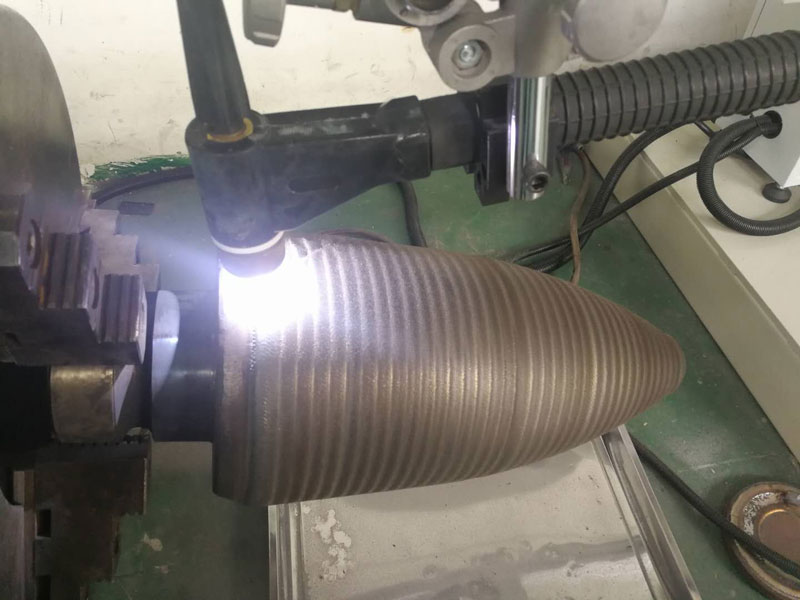
Plasma powder hardfacing process applied to piercing plug for high temperature and wear resistance
Plasma Cladding for Large Rotors and Discs
Large rotors and discs used in power generation, petrochemical processing, and heavy machinery are subject to extreme thermal and mechanical stress. Plasma cladding provides an efficient repair solution without compromising structural integrity.
By using plasma alloy powder cladding, worn shaft journals can be restored without preheating, while maintaining low heat input and minimal distortion. The restored surfaces achieve hardness levels of HRC 60 or above, with small machining allowance and no metallurgical cracking.
Plasma Cladding Process for Shaft Components
FNS applies a standardized plasma cladding and refurbishment procedure for shaft-type components:
- Surface preparation: Degreasing, rust removal, abrasive blasting, and surface leveling in damaged areas
- Non-destructive inspection: Magnetic particle testing, X-ray inspection, dye penetrant or fluorescent testing to identify hidden defects
- Plasma cladding: Application of proprietary alloy powders using plasma cladding equipment, achieving hardness up to HRC 63 without preheating
- Post-processing: Grinding, polishing, and dimensional correction of cladded zones
- Final inspection and acceptance: Re-inspection to confirm defect-free surfaces and compliance with technical requirements
After treatment, shaft components can be restored to near-new condition, significantly reducing downtime and replacement costs.
Plasma Hardening and Cladding of Large Gears
Large gears and ring gears are critical transmission components where dimensional accuracy and surface integrity are essential. Plasma quenching and plasma cladding provide precise surface strengthening with minimal thermal deformation.
Plasma quenching features low heat input, preserving gear accuracy and surface roughness. Plasma powder cladding can also be used to repair broken or severely worn gear teeth.
Typical Plasma Quenching Parameters for Gears
- Surface hardness: HRC 35–45
- Hardened layer depth: 0.4–0.6 mm
- Plasma power: 17.8 kW
- Scanning speed: 10–50 mm/s
Using CNC-controlled systems, process parameters can be adjusted by gear zone (tooth tip, flank, root), ensuring optimized performance. No tempering is required after plasma treatment, and surface finish remains stable.
Plasma Cladding Repair of Turbine Discs and Blades
In fans and turbines, discs and blades are among the most failure-prone components due to erosion, corrosion, and fatigue.
Plasma powder cladding is first used to fill grooves, pits, and surface damage on turbine discs and sidewalls. Cracks and corrosion defects are repaired, followed by plasma cladding with alloy powders matching the base material. This process requires no preheating or buffer layer, yet delivers high hardness and excellent bonding.
Plasma Repair Process for Turbine Blades
- Pre-treatment: Cleaning and surface preparation
- Defect identification: Visual inspection and instrument-based testing to locate wear zones and cracks
- Plasma cladding repair:
- Micro-cracks repaired using pulsed plasma cold welding
- Blade tip rebuilding and wear repair using plasma powder cladding
- Precise control of energy input and deposition rate prevents cracking
- Post-machining: Grinding and polishing to restore dimensional accuracy
- Quality inspection: Verification of all repaired areas
- Final finishing: Surface refinement and protective treatment
After completion, turbine blades can be fully restored for continued service, extending operating life and improving system reliability.
Why Choose FNS Pipeline Technology
With extensive experience in plasma heat treatment and plasma powder cladding, FNS Pipeline Technology Co., Ltd. provides tailored solutions for:
- Mechanical equipment refurbishment
- Petrochemical and power generation components
- Large, high-value parts with complex geometries
Our plasma solutions deliver high hardness, low dilution, minimal distortion, and long-term performance, helping customers reduce maintenance costs and maximize asset value.


