


Bimetallic Wear-Resistant Steel Pipe for Severe Abrasive Slurry and Solid Particle Transport
In mining, power generation, metallurgy, and chemical processing, pipelines carrying solid particles, slurry, ash, and slag are exposed to continuous abrasion and impact. A bimetallic wear-resistant steel pipe combines a tough structural steel outer layer with a hard alloy inner layer, providing a practical solution for high-wear conveying systems where conventional steel pipes require frequent replacement.
For pipeline engineers, the real challenge is not simply selecting a harder material. The pipe must withstand abrasion while retaining sufficient toughness, pressure resistance, weldability, and dimensional stability. This is where a properly engineered bimetallic structure can offer a significant advantage.
What Is a Bimetallic Wear-Resistant Steel Pipe?
A bimetallic wear-resistant steel pipe is a composite pipe manufactured by combining two metals with different functions.
The outer layer provides structural strength, toughness, and fabrication flexibility. Carbon steels such as Q235 or 20# can be used as the base material depending on the design requirements.
The inner layer is a high-hardness wear-resistant alloy designed to withstand direct contact with abrasive media. For many severe wear applications, high-chromium alloy systems can provide a hardness in the range of HRC 55–65.
Rather than relying on two independent components, advanced manufacturing routes such as centrifugal casting or automatic hardfacing can create a strong metallurgical interface between the layers.
This functional separation is important:
- Outer steel layer:carries structural and installation loads.
- Inner alloy layer:takes the primary abrasion and erosion.
- Metallurgical interface:transfers loads between the two layers and helps prevent separation.
The result is essentially an “outer tough / inner hard” pipeline structure designed around the actual failure mechanism of abrasive service.
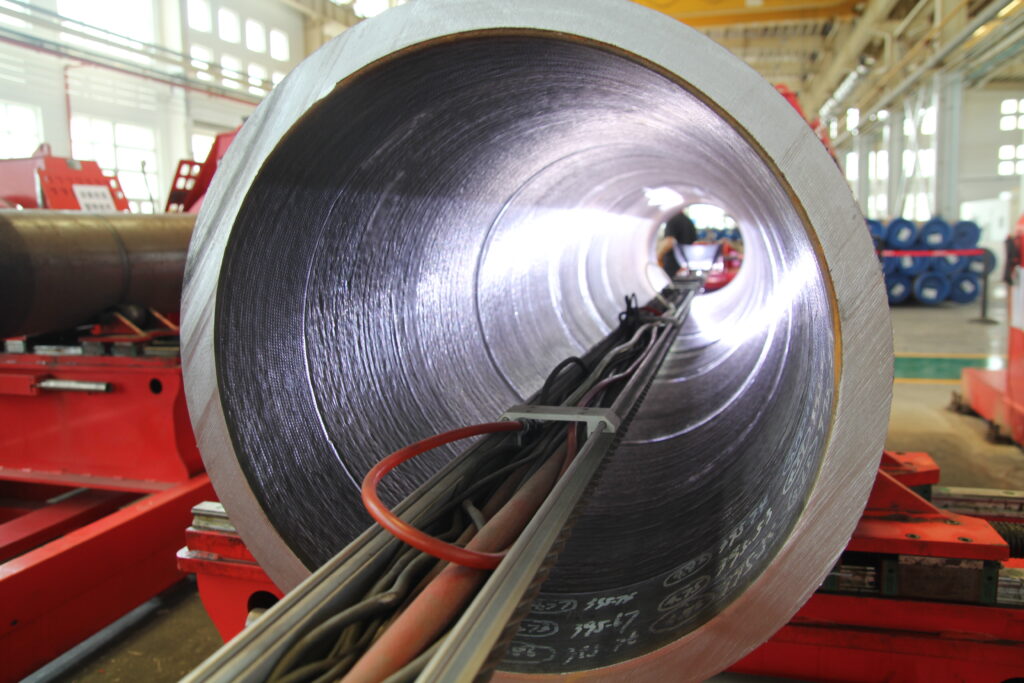
Bimetallic wear-resistant steel pipe with high chromium alloy inner layer
Why Conventional Steel Pipes Wear So Quickly
A conventional carbon steel pipe may perform well when conveying clean water, gas, or relatively non-abrasive fluids. The situation changes dramatically when the conveyed medium contains hard particles.
Typical wear mechanisms include:
1. Sliding abrasion
Fine mineral particles repeatedly slide against the pipe wall. Over time, this removes material from the internal surface and progressively reduces wall thickness.
2. Particle impact
Larger particles can strike the pipe wall at high velocity, creating localized deformation and accelerated material loss.
3. Erosive wear
When slurry or powder travels at high velocity, repeated particle impacts can create concentrated wear zones, particularly at elbows, reducers, tees, and changes in flow direction.
4. Combined corrosion and abrasion
In chemical or slurry services, corrosive liquids can attack the metal surface while solid particles continuously remove the protective surface layer. This combination can be considerably more damaging than either mechanism alone.
For this reason, selecting a pipe solely according to nominal pressure or conventional steel grade may not adequately address the actual operating conditions.
Key Advantages of Bimetallic Wear-Resistant Steel Pipe
1. High Resistance to Abrasive Wear
The high-chromium alloy inner layer is specifically designed for severe wear environments.
With hardness typically reaching HRC 55–65, the lining can effectively resist the cutting, sliding, and impact action of mineral particles, slag, ash, and other abrasive media.
In suitable operating conditions, the service life can be substantially longer than that of conventional carbon steel pipe.
However, actual service life depends on particle size, hardness, concentration, flow velocity, temperature, pipe geometry, and operating conditions. Therefore, a professional wear assessment should be performed before selecting the final wall structure.
2. Strong Metallurgical Bond
One of the major differences between an engineered bimetallic pipe and mechanically assembled composite products is the bonding method.
Through centrifugal casting or automatic hardfacing, the wear-resistant layer can be metallurgically integrated with the steel substrate.
This provides a more reliable interface and reduces the risk of:
- Delamination
- Lining separation
- Local peeling
- Cracking caused by weak interfaces
For continuously operating conveying systems, interface integrity is just as important as surface hardness.
3. Tough Outer Layer for Easier Installation
A pipe made entirely from an extremely hard alloy would not necessarily be the best engineering solution.
High hardness often comes with reduced toughness and more difficult fabrication.
The bimetallic design solves this problem by placing the hard alloy where it is actually needed—the internal wear surface—while using a tougher carbon steel substrate for structural support.
Depending on the selected base material and design, the pipe can be fabricated using conventional installation methods such as cutting and welding, subject to qualified procedures and project requirements.
4. Longer Replacement Intervals
Frequent pipeline replacement creates costs that go far beyond the price of the pipe itself.
Every replacement may involve:
- Equipment shutdown
- Removal of damaged pipe
- New pipe installation
- Welding and alignment
- Inspection
- Labor
- Production losses
A longer-lasting wear-resistant pipe can therefore reduce the frequency of planned and unplanned maintenance.
The key economic metric should not be the initial purchase price alone, but the total cost of ownership over the pipeline’s operating life.
Bimetallic Wear-Resistant Pipe vs. Conventional Steel Pipe
| Performance Factor | Conventional Steel Pipe | Bimetallic Wear-Resistant Pipe |
| Abrasion resistance | Moderate to low | High |
| Impact resistance | Depends on steel grade | Combination of hard layer and tough substrate |
| Internal hardness | Relatively low | Typically HRC 55–65 for high-chromium wear layers |
| Service life in severe abrasion | Shorter | Significantly extended in suitable conditions |
| Weldability | Generally good | Base steel remains fabrication-friendly |
| Maintenance frequency | Higher | Lower |
| Initial cost | Lower | Higher |
| Long-term operating cost | Often higher | Potentially lower |
| Suitable applications | General conveying | Severe abrasive conveying |
The important point is that hardness alone does not determine pipeline performance. The wear layer, substrate, bonding quality, pipe geometry, and operating conditions must work together.
Where Are Bimetallic Wear-Resistant Pipes Used?
The technology is particularly useful when a pipeline transports abrasive materials continuously.
Mining
Mining pipelines may transport:
- Ore slurry
- Tailings
- Concentrate
- Mineral powder
- Backfill materials
Hard mineral particles can rapidly attack conventional pipe walls, especially at elbows and other areas with turbulent flow.
Power Plants
Typical applications include:
- Fly ash conveying
- Bottom ash systems
- Coal powder transportation
- Slag handling
The combination of abrasion and continuous operation makes wear-resistant pipe an attractive option for critical conveying lines.
Metallurgical Plants
Steelmaking and metallurgical processes generate abrasive materials such as slag, dust, scale, and particulate waste.
Wear-resistant composite piping can be used in selected material-handling systems where conventional pipes experience rapid wall loss.
Chemical Processing
Some chemical processes involve solid particles combined with corrosive liquids. In these conditions, material selection needs to consider both abrasion and corrosion rather than treating them as separate problems.
Straight Pipes Are Not the Only Application
A common mistake in pipeline wear management is focusing only on straight pipe sections.
In practice, wear is often concentrated at flow disturbances.
FNS can apply wear-resistant solutions to different pipeline components, including:
- Straight pipes
- Long-radius elbows
- Short-radius elbows
- Tees
- Reducers
- Expansion sections
- Transition pieces
- Customized wear components
The wear layer thickness and alloy composition can be engineered according to the expected service conditions.
For example, an elbow carrying high-velocity mineral slurry may require a different wear allowance from a straight pipe carrying the same material because the change in flow direction can significantly increase localized erosion.
FNS Approach to Wear-Resistant Pipeline Engineering
At FNS Pipeline Technology Co., Ltd., the objective is not simply to add a hard layer to a pipe. The more important question is:
Where will the pipeline actually fail, and what material structure can prevent that failure?
Our approach can involve several stages.
Step 1: Understand the Service Conditions
The pipeline design should consider:
- Conveyed medium
- Particle hardness
- Particle size
- Solid concentration
- Flow velocity
- Operating temperature
- Pressure
- Corrosive environment
- Pipeline geometry
These factors determine the dominant wear mechanism.
Step 2: Select the Substrate
A suitable carbon steel or other structural material can be selected according to pressure, fabrication, installation, and environmental requirements.
Step 3: Engineer the Wear Layer
The alloy system and layer thickness can be selected according to the expected abrasion and impact conditions.
High-chromium alloys are suitable for many abrasive applications, while other alloy systems may be considered when corrosion, elevated temperature, or severe impact becomes the dominant concern.
Step 4: Control the Hardfacing Process
Automatic hardfacing can provide controlled deposition and more consistent coating thickness.
Process control is particularly important for large-diameter pipes and components because uneven deposition can create machining and dimensional problems later.
Step 5: Inspection and Finishing
After hardfacing, the component can undergo dimensional inspection, visual examination, hardness testing, and appropriate NDT according to project requirements.
Machining can then be performed where required to achieve the specified dimensions and installation tolerances.
A Better Way to Calculate Pipeline Wear Cost
Replacing a pipe every few months may appear inexpensive when viewed from the purchase order alone.
But consider a simplified lifecycle calculation:
Total wear-pipeline cost = Pipe cost + installation cost + maintenance cost + downtime cost + production loss
This explains why a higher-performance pipe can sometimes deliver a lower overall operating cost despite having a higher initial purchase price.
For mining and mineral-processing operations, where one hour of unexpected shutdown can affect upstream and downstream equipment, extending the replacement interval can have a much greater financial impact than simply reducing the pipe purchase price.
FNS Bimetallic Wear-Resistant Pipe: Designed for the Wear Zone
A good wear-resistant pipeline does not need to make the entire pipe extremely hard.
It needs to put the right material in the right location.
The bimetallic wear-resistant steel pipe concept achieves this by combining the structural advantages of a tough steel substrate with the wear resistance of a high-hardness alloy layer.
For abrasive slurry, ash, slag, mineral powder, and solid-particle conveying systems, this approach can help reduce wall loss, extend maintenance intervals, and improve the reliability of critical pipelines.
For FNS, the next step is not simply selecting a standard wear-resistant pipe. It is matching the composite structure, alloy, layer thickness, dimensions, and manufacturing process to the actual operating conditions of the customer’s pipeline.
If your existing pipeline is suffering from repeated wear-through, leakage, or frequent replacement, FNS can help evaluate the wear mechanism and develop a more suitable wear-resistant pipe solution.
FAQ: Bimetallic Wear-Resistant Steel Pipe
1. What is a bimetallic wear-resistant steel pipe?
It is a composite pipe consisting of a tough structural steel substrate and an internal wear-resistant alloy layer. The two layers are joined through a controlled manufacturing process to provide both structural strength and abrasion resistance.
2. How hard is the wear-resistant layer?
For high-chromium alloy systems, the hardness can typically reach approximately HRC 55–65. The appropriate hardness depends on the selected alloy and operating conditions.
3. Is a harder pipe always better for mining applications?
No. Excessive hardness does not automatically mean longer service life. Particle impact, material toughness, temperature, slurry concentration, and flow velocity must also be considered.
4. Can bimetallic pipes be welded?
The feasibility depends on the substrate, wear-layer configuration, joint design, and welding procedure. Welding should be carried out according to an appropriate qualified procedure to avoid damaging the composite structure.
5. Can these pipes be used for slurry transportation?
Yes. They are particularly suitable for abrasive slurry and mineral-particle conveying applications where conventional carbon steel pipes experience rapid internal wear.
6. What industries use these pipes?
Typical applications include mining, power generation, metallurgy, cement, chemical processing, and other industries handling abrasive solids, slurry, ash, or slag.
7. How does FNS select the wear layer?
FNS considers the conveyed material, particle characteristics, flow velocity, temperature, pressure, corrosion conditions, pipe geometry, and expected service life before recommending the alloy and layer structure.
8. Can FNS manufacture elbows and other fittings?
Yes. Wear-resistant solutions can be engineered for straight pipes as well as elbows, tees, reducers, transitions, and other customized pipeline components.


