


Smooth, Weld-Bead-Free Wear Plate for Mining Chutes: A Practical Solution to Material Build-Up
Smooth wear plate for mining chutes addresses an often-overlooked cause of material build-up: the surface condition of the liner itself.
In mining transfer systems, wet, fine and sticky ores are naturally difficult to handle. However, material moisture is not always the whole story. When a chute is lined with conventional hardfaced wear plate, the raised welding beads on the working surface can create small steps where fine particles collect. As these deposits grow, they can form a compacted layer or even a bridge across the material flow path.
The result is familiar to many mine operators: restricted flow, sudden blockage, manual cleaning, unplanned shutdowns and additional maintenance work.
This is where smooth wear plate for mining chutes takes a different approach. Instead of accepting a rough, bead-patterned surface as an unavoidable feature of hardfacing, FNS develops a wear-resistant working surface that is flat and smooth, with a surface roughness of Ra <9 μm.
The objective is straightforward: reduce the opportunity for sticky material to remain on the liner while maintaining consistent wear resistance.
The Hidden Relationship Between Surface Roughness and Chute Blockage
A chute liner does more than resist abrasion. Its surface also directly interacts with the material being transported.
Conventional overlay wear plates often contain visible weld beads. These raised areas can create:
- Local depressions between adjacent beads
- Small mechanical steps that retain wet particles
- Uneven contact with flowing material
- Localized accumulation of fine ore
- Stress concentrations around the deposited bead structure
For dry and free-flowing materials, these effects may not be critical. The situation changes when the feed contains moisture, clay, fine particles or other sticky components.
Once a small amount of material remains attached to the liner, subsequent particles can adhere to the existing deposit. What begins as a thin layer can gradually become a large build-up area.
Therefore, chute blockage prevention should not focus only on changing the conveyed material or increasing cleaning frequency. The liner surface itself deserves attention.
FNS Smooth Wear Plate: A Different Surface Design
FNS focuses on controlling both the wear layer and the working surface.
The key feature is a smooth, weld-bead-free surface with a measured roughness of Ra <9 μm.
1. Flat working surface
The liner surface is designed without the pronounced raised weld beads commonly associated with traditional hardfaced plates.
A flatter surface gives fine particles fewer locations to catch and accumulate.
2. Lower tendency for material adhesion
For wet or fine mineral materials, reducing surface irregularities can help limit mechanical anchoring and material retention.
The smoother surface does not mean that sticking can be eliminated under every operating condition. Material moisture, particle size, chute angle, impact velocity and feed rate still matter. However, removing unnecessary surface steps addresses one controllable factor in the system.
3. Consistent wear resistance
The wear-resistant layer is metallurgically bonded to the substrate. Instead of relying on a mechanically attached coating, the alloy layer forms a strong metallurgical interface with the base material.
This supports a more consistent wear-resistant surface without deliberately creating raised bead profiles.
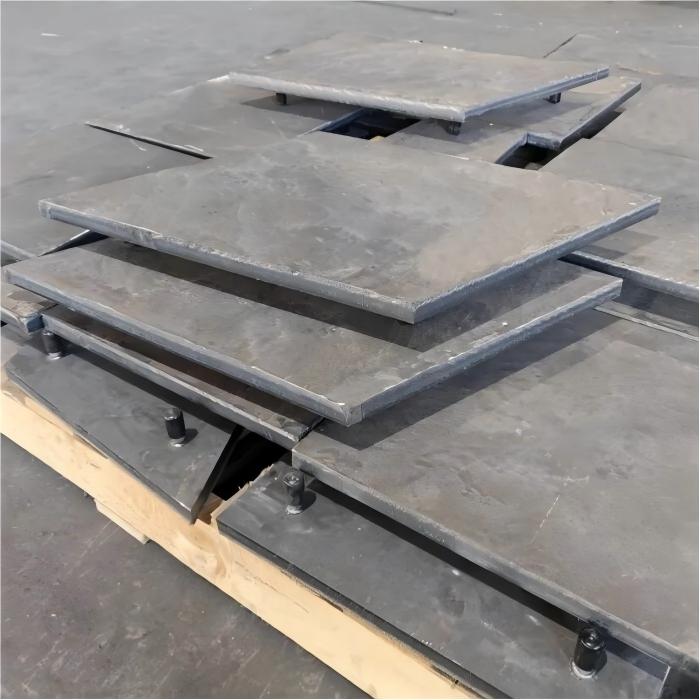
FNS smooth wear plate for mining chute with flat weld-bead-free surface
Why a Smooth Surface Matters More in Wet and Fine Ore Handling
The difference becomes particularly important when handling materials such as:
- Wet iron ore fines
- Copper ore slurry-related solids
- Clay-containing minerals
- Fine coal
- Moist concentrates
- Sticky crushed ore
- Other abrasive and cohesive bulk materials
Consider two liner surfaces.
| Conventional Hardfaced Liner | FNS Smooth Wear Plate |
| Raised welding beads | Flat working surface |
| Pronounced surface profile | Weld-bead-free surface |
| Material can collect between beads | Reduced mechanical retention |
| Local bead geometry can influence wear | More uniform working surface |
| Build-up may develop around surface steps | Designed to reduce build-up tendency |
| Cleaning may become frequent in sticky service | Helps reduce blockage-related maintenance |
The important point is that surface smoothness and wear resistance are not necessarily competing requirements. With appropriate cladding technology and surface treatment, both can be considered in the same liner design.
Metallurgical Bonding Helps Keep Wear Performance Uniform
A smooth surface alone is not enough for a mining chute liner.
If the wear-resistant layer contains weak areas, premature local wear can expose the substrate even when the surface initially performs well.
FNS uses a metallurgically bonded alloy wear layer to provide a more consistent wear-resistant structure.
This is significant because chute liners are subjected to different combinations of impact, sliding abrasion and particle pressure. Local weak points can become initiation sites for accelerated wear.
With a metallurgical bond and controlled alloy layer, the wear surface can maintain more uniform resistance across the working area.
The combination matters
The practical value of the FNS solution comes from combining two characteristics:
Smooth working surface + uniform metallurgically bonded wear layer
The first addresses material retention and build-up.
The second addresses abrasive wear.
That makes the liner a more comprehensive response to the two problems commonly encountered in transfer chutes.
Smooth Wear Plate for Mining Chutes: More Than a Wear-Resistance Upgrade
When a chute repeatedly blocks, the obvious response is often to increase liner thickness or select a harder material.
That approach may solve part of the problem, but not necessarily the whole problem.
If the underlying issue is that wet fines are repeatedly catching on a rough liner surface, increasing hardness does not remove the source of material retention.
A more practical approach is to consider the complete operating mechanism:
Material characteristics → liner surface → material flow → build-up → blockage → maintenance
This is why smooth wear plate for mining chutes can be valuable in applications where both abrasion and material build-up are present.
Instead of treating wear and blockage as completely separate issues, the liner is designed around the actual interaction between the transported material and the working surface.
Can Replacing the Liner Alone Reduce Chute Problems?
In many existing systems, operators may assume that solving chute blockage requires changing the chute angle, adding vibration equipment or redesigning the transfer point.
Sometimes those modifications are necessary. But they are not always the first step.
If the chute structure itself is fundamentally suitable, replacing a problematic liner with a smoother wear-resistant liner can be a comparatively simple improvement.
The potential advantages include:
- No major chute reconstruction
- No change to the overall transfer system
- Reduced dependence on manual cleaning
- Better use of existing chute geometry
- Simultaneous attention to wear and material build-up
- Easier maintenance planning
For existing mining plants, this makes liner replacement a practical option for testing whether surface condition is contributing to recurring blockage.
Where FNS Smooth Wear-Resistant Plates Can Be Applied
The technology is particularly relevant to equipment exposed to abrasive materials combined with adhesion or build-up.
Typical applications include:
Mining Transfer Chutes
Transfer points experience continuous impact and sliding abrasion. A smooth working surface can be especially useful where wet fines tend to accumulate.
Ore Receiving and Discharge Chutes
Large quantities of ore passing through a restricted flow path can quickly turn a small build-up area into a serious blockage.
Crusher Discharge Areas
Crushed materials can contain a wide range of particle sizes. Fine particles may remain attached to liner irregularities while larger particles continue to impact the surface.
Screening and Conveying Systems
Where fine, moist material is transferred between conveyors and processing equipment, liner surface condition can influence both flow and maintenance requirements.
Mineral Processing Equipment
Concentrates and processed minerals may be particularly prone to adhesion depending on moisture and particle characteristics.
FNS Approach: Solve the Problem at the Contact Surface
The most useful wear-resistant liner is not necessarily the hardest plate available.
For chute applications, engineers should consider at least four factors:
- Abrasion resistance– Can the liner withstand the expected wear mechanism?
- Impact resistance– Can it tolerate the incoming material and operating conditions?
- Surface condition– Will the working surface encourage or discourage material retention?
- Bond integrity– Will the wear layer remain reliable throughout its service life?
FNS combines surface engineering with wear-resistant material design to address these factors together.
The result is a smooth wear-resistant plate intended for applications where conventional hardfaced surfaces may create an additional build-up problem.
A More Practical Way to Reduce Chute Maintenance
Chute blockage is rarely caused by one factor alone. Moisture, particle size, material chemistry, chute geometry, flow velocity and liner condition can all interact.
But that does not mean every solution has to involve a major equipment modification.
When the liner surface is contributing to build-up, changing the liner can be one of the simplest points of intervention.
The FNS concept is therefore not simply “make the wear plate harder.” It is:
Create a wear-resistant working surface that is also suitable for continuous material flow.
With a surface roughness of Ra <9 μm, no prominent weld-bead profile and a metallurgically bonded alloy wear layer, the FNS liner is designed to address both abrasive wear and material accumulation at the chute surface.
FAQ
1. Why do wet materials build up on conventional hardfaced wear plates?
Raised welding beads and surface irregularities can provide mechanical retention points for wet fines. Once a small amount of material remains on the surface, additional particles can accumulate around it.
2. What surface roughness does the FNS smooth wear plate achieve?
The stated surface roughness is Ra <9 μm, providing a flat and smooth working surface without prominent weld-bead protrusions.
3. Does a smooth liner completely prevent chute blockage?
No liner can guarantee zero blockage under all conditions. Material moisture, clay content, particle size, chute angle, flow rate and other operating factors also influence build-up. A smoother surface removes one important source of mechanical retention.
4. How is the FNS wear layer bonded to the base plate?
The wear-resistant alloy layer is metallurgically bonded to the substrate, providing a stable interface and more uniform wear performance.
5. Is the FNS liner suitable for existing mining chutes?
Where the existing chute structure and dimensions are suitable, replacing the existing liner can be considered without major structural modification. The final plate design should be based on the actual chute dimensions and operating conditions.
6. What is the difference between smooth wear plate and conventional hardfaced plate?
The major difference is the working-surface profile. Conventional hardfaced plates commonly have raised deposition beads, while FNS develops a flatter, weld-bead-free surface with Ra <9 μm, while retaining a metallurgically bonded wear-resistant layer.
7. Can FNS recommend a liner for a specific mineral?
Yes. Liner selection should consider the material’s abrasiveness, moisture, particle size, impact energy, conveying rate and existing chute geometry. These parameters can be used to develop a more suitable wear-resistant liner solution.


