


Laser Cladding Best Practices for High-Quality Surface Repair
Laser cladding is a high-precision, high-efficiency surface repair and enhancement technology widely used across energy, pipeline, mold, and heavy industrial sectors. At FNS Pipeline Technology Co., Ltd., laser cladding is applied to restore worn components, improve surface performance, and extend service life while maintaining strict dimensional control.
To achieve stable, repeatable results, the following laser cladding best practices are essential.
1. Optimize Laser Power and Scanning Speed
Laser power and scanning speed directly determine melt pool stability and cladding quality.
- Excessive laser power can lead to an overly deep or wide melt pool, increasing dilution and distortion.
- Insufficient power may prevent proper metallurgical bonding.
- Scanning too fast reduces penetration depth, while slow speeds can cause overheating and deformation.
For each material and defect type, FNS engineers determine optimal parameters through controlled testing to ensure consistent results.
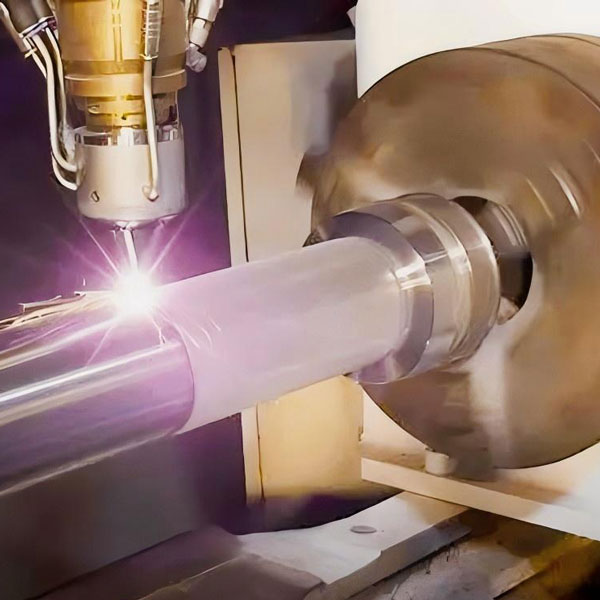
Laser cladding repair on wind turbine main shaft by FNS Pipeline Technology Co., Ltd
2. Precisely Control Melt Pool Temperature and Depth
Melt pool temperature and depth influence microstructure, bonding strength, and wear resistance. These factors must be adjusted through a combination of:
- Laser power density
- Scanning speed
- Scanning path strategy
For large components such as die-casting molds or pipeline parts, multi-track or staggered scanning helps maintain a uniform and stable cladding layer.
3. Ensure High-Quality Contact Between Melt Pool and Substrate
Strong metallurgical bonding depends on effective contact between the melt pool and the base material. Surface contamination, oxidation, or poor preparation can weaken adhesion.
At FNS Pipeline Technology Co., Ltd., substrates are thoroughly cleaned and, when necessary, preheated to improve wettability and bonding strength.
4. Control Temperature Distribution in the Cladding Zone
Uneven temperature distribution may cause cracking, residual stress, or localized deformation. This risk increases when repairing large or thick components.
By optimizing laser parameters and scan paths, including multi-point and alternating scanning methods, FNS ensures uniform heat input and stable cladding quality.
5. Select the Right Cladding Material and Composition
The performance of a laser cladding layer depends heavily on material selection. Cladding powders or wires must:
- Match the substrate in thermal and metallurgical properties
- Meet specific requirements for wear resistance, corrosion resistance, or hardness
Material compatibility is always evaluated to minimize dilution and ensure long-term durability.
6. Control Cladding Layer Thickness and Surface Quality
Cladding thickness directly affects repair effectiveness and service life:
- Layers that are too thin may fail to restore the damaged surface
- Excessively thick layers can destabilize the melt pool and cause distortion
Precise control of melt pool depth and laser energy density ensures uniform thickness and high surface integrity.
7. Maintain Laser Equipment and Control the Working Environment
Laser cladding relies on high-precision equipment and stable operating conditions. Regular maintenance, accurate calibration, and proper shielding are essential.
At FNS, laser systems are inspected before each operation, and environmental factors such as dust, temperature, and safety protection are strictly controlled.
8. Conduct Comprehensive Testing and Performance Evaluation
Before full-scale application, laser cladding processes must be validated through:
- Parameter optimization trials
- Cladding layer thickness and microstructure inspection
- Mechanical property and durability testing
These evaluations ensure that the repaired surface meets performance expectations and provides reliable long-term service.
Why Choose FNS Pipeline Technology Co., Ltd. for Laser Cladding?
With extensive experience in pipeline components, industrial parts, and surface engineering, FNS Pipeline Technology Co., Ltd. delivers laser cladding solutions that combine precision, consistency, and durability. Each project is supported by material expertise, process validation, and strict quality control.


