

Wear Resistant Dredging Pipes for Port, Harbor and Deep-Sea Reclamation Projects
Port dredging, sediment transport and land reclamation place severe demands on pipeline systems. Wear resistant dredging pipes must withstand continuous abrasion from sand, gravel, crushed shells and other hard particles while handling seawater exposure, pressure fluctuations and mechanical vibration. For contractors working on harbor deepening, port expansion and offshore reclamation, premature pipe wear can lead to costly shutdowns and reduced pumping efficiency. FNS Pipeline Technology Co., Ltd. provides customized wear protection solutions, including bimetallic hardfacing pipes and ceramic-lined pipes, to meet the demanding conditions of modern dredging projects.
Why Wear Resistance Matters in Port and Harbor Dredging
Dredging pipelines transport mixtures of water, sediment and solid particles over considerable distances. Depending on the project, the conveyed material may contain fine sand, coarse gravel, shell fragments and other abrasive solids. As these particles move through the pipeline, they gradually remove material from the internal surface.
The severity of wear depends on several factors, including particle hardness, solids concentration, flow velocity, particle size and pipeline geometry. Bends, reducers and other changes in flow direction can experience particularly intense localized erosion.
Seawater introduces another challenge. Chlorides and other dissolved substances can accelerate corrosion in susceptible materials, while offshore installations may also experience vibration, pressure variations and demanding maintenance conditions.
Selecting the right wear resistant dredging pipes therefore requires more than choosing a material with high hardness. The pipe must provide an appropriate balance of abrasion resistance, structural strength, corrosion protection and practical maintainability.
For port authorities, dredging contractors and marine engineering companies, a suitable pipe design can help reduce unplanned replacement, improve equipment availability and support more predictable maintenance planning.
FNS Wear Protection Solutions for Dredging Pipelines
FNS Pipeline Technology develops wear-resistant pipeline solutions using different material technologies. Two important options are bimetallic hardfacing pipes and ceramic-lined pipes. Their suitability depends on the characteristics of the conveyed material and the operating conditions.
1. Bimetallic Hardfacing Pipes
Bimetallic hardfacing pipes combine a structural base material with a wear-resistant alloy layer deposited onto the internal surface through a controlled welding process.
The base material provides the principal structural support, while the hardfacing layer is designed to resist abrasive material flow. Depending on the selected alloy and fabrication procedure, the overlay can be tailored to the anticipated wear mechanism.
Potential advantages include:
High abrasion resistance: A properly selected hardfacing alloy helps protect the pipe wall against continuous contact with sand and other abrasive solids.
Application-specific engineering: Alloy composition, overlay thickness and pipe dimensions can be selected according to project requirements.
Structural support: The base pipe carries the mechanical loads specified in the engineering design.
Localized wear protection: The internal surface can be engineered for areas exposed to more severe abrasion.
For dredging pipelines that transport high concentrations of abrasive solids, bimetallic hardfacing offers a practical approach to combining structural support with internal wear protection.
The final performance depends on the alloy, overlay quality, operating temperature, impact conditions and installation method. Where seawater corrosion is a concern, the corrosion resistance of the selected materials must also be evaluated.
2. Ceramic-Lined Pipes
Ceramic-lined pipes use a ceramic wear layer to protect the internal surface from abrasive particles. Their high hardness makes them a potential option for applications dominated by sliding abrasion.
In suitable operating conditions, ceramic linings can reduce direct wear on the structural pipe wall and extend the interval between maintenance operations.
However, ceramic and metallic hardfacing do not behave identically. Ceramics are generally more brittle than metallic materials, so impact loads, vibration, joint design and thermal or mechanical stresses must be considered carefully.
For dredging services involving coarse gravel, shell fragments or irregular solid particles, the suitability of a ceramic lining should be assessed against the actual impact conditions rather than hardness alone.
FNS can evaluate the application and help determine whether a ceramic-lined design or a bimetallic hardfacing solution is more appropriate.
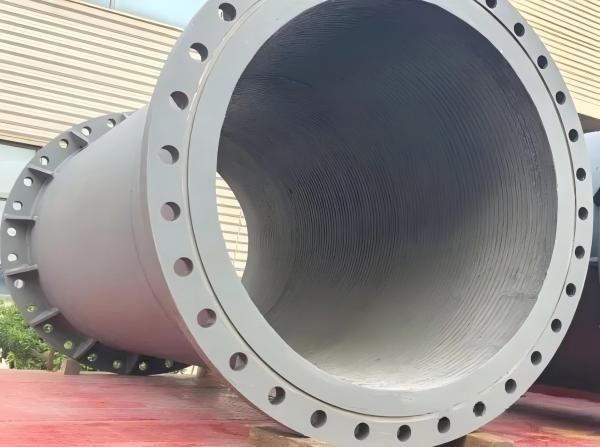
FNS wear resistant dredging pipe for port and harbor sediment transport
A Layered Wear Protection Strategy for Severe Operating Conditions
Some demanding dredging applications require more than a single wear-resistant material. A layered structure can be considered where the design must balance surface hardness, impact tolerance and load-bearing capacity.
The proposed engineering concept incorporates three functional layers:
| Structural layer | Primary function | Engineering consideration |
| High-hardness wear-resistant surface | Resists abrasive contact from sand, gravel and other solids | Hardness, wear mechanism and surface integrity |
| Tough intermediate layer | Helps accommodate stresses and mitigate the effects of impact | Toughness, bonding quality and compatibility between layers |
| High-strength structural base | Supports the pipe assembly and withstands specified mechanical loads | Base material, wall thickness, pressure and installation loads |
This gradient approach aims to combine the wear resistance of the surface with the toughness and strength required beneath it.
The precise construction depends on the selected technology. A bimetallic hardfacing pipe and a ceramic-lined pipe have different material interfaces and failure mechanisms; the three-layer concept should therefore be engineered for the chosen product rather than assumed to be identical across both designs.
For demanding port and offshore applications, the design review should also address seawater exposure, particle impact, pipeline supports, joint connections and inspection requirements.
Wear Resistant Pipes for Deep-Sea Sand Transport and Reclamation
Deep-sea sand extraction and offshore reclamation can involve long transport routes, significant elevation differences and demanding installation conditions. In some projects, sand is extracted from water depths exceeding 200 meters and transported over distances greater than 50 kilometers to artificial islands, port expansion zones or other reclamation areas.
These figures describe challenging project scenarios rather than universal operating requirements. Actual pipeline length, working depth and pumping configuration depend on the project design.
As the transport distance increases, the pipeline system must be evaluated for pressure losses, pumping requirements, structural loading, connection integrity and wear distribution. At substantial depths, external hydrostatic pressure and installation loads may also become important design considerations.
In these applications, wear resistant dredging pipes need to be selected as part of the complete transport system, not as isolated components. Pipe material, internal diameter, wall thickness, bend geometry, joint configuration and wear protection must work together.
FNS can support customized pipeline engineering for demanding sand transport and reclamation projects, with material and structural options assessed against the actual service conditions.
Key Design Considerations for Long-Distance Dredging
Abrasive slurry characteristics
The concentration and particle-size distribution of the transported solids influence wear rates. Coarse particles and high solids loading may create different wear patterns from fine, relatively uniform sediment.
Flow velocity and pressure
Higher flow velocity can increase particle impact and abrasion, while the required pumping pressure depends on pipeline length, elevation, friction losses and slurry properties. Both factors should be considered when specifying the pipe.
Depth and mechanical loading
Offshore installations may encounter hydrostatic pressure, suspended-pipeline loads, seabed movement and installation stresses. These conditions require appropriate structural assessment and connection design.
Corrosion exposure
Seawater compatibility should be evaluated for the base material, exposed surfaces, joints and any areas where the protective lining or overlay may be damaged.
Inspection and maintenance
Wear monitoring, accessible inspection points and practical replacement procedures can help reduce unexpected downtime and support lifecycle cost management.
Customized Dredging Pipeline Solutions from FNS
No single pipe construction is ideal for every dredging project. A pipeline carrying fine sand under relatively stable conditions may have different requirements from one transporting gravel-rich slurry through bends or operating in a deep offshore environment.
FNS Pipeline Technology works with project-specific requirements to assess appropriate wear protection technologies and pipeline configurations. Depending on the application, the proposed solution may incorporate bimetallic hardfacing, ceramic lining or a customized layered structure.
The engineering review can cover:
Pipe dimensions, wall thicknesses and connection requirements.
Abrasive particle characteristics and slurry concentration.
Operating pressure, flow velocity and transport distance.
Seawater exposure and corrosion protection requirements.
Wear-prone bends, reducers and other pipeline components.
Installation conditions, inspection access and maintenance planning.
By considering these factors before fabrication, project teams can make more informed decisions about material selection and pipeline service life.
For contractors involved in harbor dredging, offshore sand transport and land reclamation, the goal is to reduce avoidable wear-related interruptions while maintaining the structural reliability required for the intended service.
Supporting More Efficient and Sustainable Dredging Operations
Pipeline wear affects more than the replacement cost of an individual component. Frequent repairs can interrupt dredging schedules, require additional labor and equipment mobilization, and generate more discarded pipe material.
Appropriately engineered wear resistant dredging pipes can help reduce these losses by extending component life under suitable operating conditions and making maintenance requirements more predictable.
A longer service interval may also reduce material consumption and the environmental burden associated with repeated manufacturing, transport and replacement. The actual benefits depend on operating conditions, product durability and the maintenance strategy adopted by the project.
As port development, maritime trade and coastal reclamation continue to create demand for reliable slurry transport systems, wear protection will remain an important consideration in pipeline lifecycle planning.
FNS Pipeline Technology Co., Ltd. provides customized wear-resistant pipeline solutions for demanding industrial and marine applications. Contact FNS to discuss your dredging project, compare hardfacing and ceramic lining options, and identify a suitable configuration for your operating conditions.
Frequently Asked Questions
1. What are wear resistant dredging pipes used for?
They are used to transport abrasive mixtures of water, sand, gravel, sediment and other solid particles in dredging and reclamation operations. Typical applications include harbor deepening, channel maintenance, offshore sand transport, port expansion and artificial island construction.
2. What is the difference between bimetallic hardfacing pipes and ceramic-lined pipes?
Bimetallic hardfacing pipes use a metallic wear-resistant alloy layer bonded to a structural base through a welding process. Ceramic-lined pipes use a hard ceramic internal lining. Hardfacing can be considered where a combination of abrasion resistance and metallic toughness is required, while ceramic lining may suit applications dominated by sliding abrasion. Impact conditions, corrosion exposure and installation requirements determine the appropriate choice.
3. Can wear-resistant pipes handle seawater and abrasive slurry simultaneously?
They can be designed for applications involving both abrasive solids and seawater, provided the materials and construction are suitable for the actual environment. Abrasion resistance does not automatically guarantee corrosion resistance, so the base material, protective layer, joints and exposed surfaces should be evaluated separately.
4. Are these pipes suitable for deep-sea sand transport over distances exceeding 50 km?
Potentially, but suitability cannot be established by wear resistance alone. Long-distance offshore transport requires assessment of pipeline pressure losses, pumping capacity, structural loads, installation depth, connection integrity and slurry properties. The complete system should be engineered and validated for the intended project.
5. How does a layered wear-resistant pipe improve performance?
A properly engineered layered construction assigns different functions to different materials. The surface resists abrasion, an intermediate layer may help accommodate impact and stress, and the base provides structural support. The effectiveness depends on material compatibility, bonding quality, layer thickness and the actual operating conditions.
6. How can I choose the right wear-resistant pipe for a dredging project?
Start with the transported material, particle size, solids concentration, flow velocity, working pressure, pipeline diameter, transport distance and seawater exposure. Also provide drawings, bend and reducer details, installation conditions and expected maintenance intervals. These details help determine whether hardfacing, ceramic lining or another customized construction is appropriate.
7. Can FNS customize wear-resistant pipes for port and reclamation projects?
FNS Pipeline Technology can assess project drawings, operating parameters and wear-protection requirements to develop a suitable customized solution. Final material selection, dimensions, manufacturing details and performance expectations are confirmed through engineering review.


