


High Temperature Wear Resistant Pipe for Direct Reduced Iron Conveying
In direct reduced iron (DRI) conveying systems, pipework must withstand continuous material abrasion, reducing gas corrosion and demanding operating temperatures of up to 1000°C while maintaining the required pressure capacity. A standard steel pipe may suffer accelerated wear, premature failure and repeated shutdowns under these conditions. FNS Pipeline Technology Co., Ltd. develops a high temperature wear resistant pipe solution with a layered structure and replaceable inner sleeve, designed to address the maintenance challenges of demanding iron and steel production processes.
Why DRI Conveying Requires a Specialized Pipe Design
Direct reduced iron production places severe demands on conveying equipment. Hot iron-bearing material moving through pipelines can gradually erode the internal surface, particularly at locations exposed to concentrated flow impact. At the same time, the surrounding reducing atmosphere can create additional corrosion challenges, depending on gas composition and operating conditions.
When the inner wall wears through, conventional piping may require extensive replacement work. This increases maintenance costs, interrupts material transfer and puts pressure on production schedules.
A purpose-designed high temperature wear resistant pipe must therefore do more than provide a hard internal surface. It needs to combine wear protection, structural strength, pressure-bearing capacity and a practical maintenance strategy within one engineered assembly.
FNS addresses these requirements through a composite pipe configuration tailored to the actual operating conditions of DRI conveying systems.
Composite Structure with a Replaceable Wear Sleeve
The FNS composite DRI conveying pipe consists of an outer structural shell and an inner wear-resistant sleeve. Each component serves a distinct function.
Outer Shell for Structural Support and Pressure Requirements
The outer shell provides the main structural support for the pipe assembly and helps maintain the integrity of the installed pipeline. Its material and wall thickness can be selected according to the engineering design, pressure requirements and operating environment.
This separation of functions allows the outer shell to provide structural support while the inner sleeve serves as the primary wear-protection component.
Replaceable Inner Sleeve to Simplify Maintenance
The inner sleeve is designed to be replaceable. When the wear allowance is consumed, maintenance teams can assess and replace the affected sleeve instead of automatically replacing the entire pipe assembly, subject to the pipe design and inspection results.
This approach can reduce the amount of material discarded during maintenance, limit replacement work and shorten planned downtime. It is particularly useful for conveying lines where internal abrasion is a recurring maintenance concern.
For plant operators, the benefit of this high temperature wear resistant pipe design lies in its maintainability as well as its resistance to demanding service conditions.
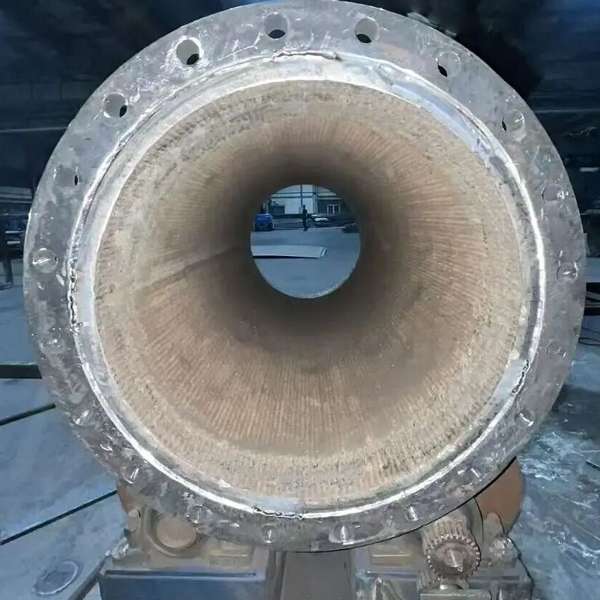
High-alloy weld overlay on a customized abrasion resistant pipe for high-temperature service
Optimized Weld Layout for Abrasive Material Flow
Weld geometry and orientation can influence local wear in a pipeline carrying abrasive solids. If weld beads or raised weld profiles are positioned unfavorably, they may become preferential points of material impact and erosion.
FNS optimizes the weld layout by arranging the weld seams along the material flow direction. This design helps reduce direct interception of the moving material by transverse weld features and lowers the risk of localized weld-related wear.
The internal wear layer is deposited using a dedicated high-alloy welding wire. The resulting weld overlay can achieve a hardness of HRC 54–57, according to the supplied product specification.
This high-hardness layer is intended to resist abrasive wear, while the selected alloy system and welding procedure are designed around the thermal and chemical conditions of the application.
Hardness alone, however, does not establish service life at 1000°C. Final material selection and qualification should also consider elevated-temperature hardness retention, oxidation and corrosion behavior, thermal cycling, weld integrity and the actual composition of the reducing gas.
For this reason, FNS can develop the high temperature wear resistant pipe configuration around the customer’s process conditions rather than relying on a single standard construction for every installation.
Customized Pipe Dimensions and Geometries
DRI conveying systems frequently include non-standard pipe dimensions, transitions and space-constrained connections. FNS supports customized fabrication to accommodate different pipeline layouts and equipment interfaces.
| Customization item | Available range or option |
|---|---|
| Straight pipe diameter | 25 mm to 4000 mm |
| Conical pipe configurations | Concentric and eccentric cone designs |
| Reducer diameter difference | Adjustable from 50 mm to 300 mm |
| Base materials | Carbon steel, stainless steel and other agreed materials |
| Applicable dimensional requirements | GB, ASME/ANSI and other specified standards, subject to design review |
| Pipe construction | Outer structural shell with replaceable inner wear sleeve |
| Internal wear protection | High-alloy weld overlay, with specified hardness of HRC 54–57 |
Note: Final dimensions, tolerances, materials, pressure ratings and manufacturing standards are confirmed against the approved drawings and project specifications.
Concentric and Eccentric Conical Sections
Concentric reducers provide a symmetrical transition between different pipe diameters, while eccentric reducers allow the centerline or one side of the pipe to remain aligned according to the installation requirements.
FNS can customize both configurations to suit the available space, flow arrangement and connection dimensions. Reducer diameter differences can be adjusted within the specified 50–300 mm range, subject to the final design.
For projects involving large-diameter transfer lines or complex pipeline routing, these fabrication options help integrate wear protection into the complete piping layout.
Flexible Base Material Selection
Carbon steel and stainless steel can be considered for the outer shell and other structural components, depending on the required mechanical properties, temperature exposure, corrosion environment and pressure conditions.
The material of the replaceable sleeve and its high-alloy wear layer must be selected separately where appropriate. Compatibility between the base material, overlay, operating temperature and thermal expansion behavior should be reviewed during engineering.
FNS can work from customer drawings, equipment interfaces and operating parameters to develop a high temperature wear resistant pipe assembly suited to the intended service.
Engineering Considerations for 1000°C Service
Operating at 1000°C introduces material and design challenges that cannot be resolved by hardness specifications alone. Before manufacturing, several factors should be evaluated:
- Temperature exposure: Determine whether 1000°C is the continuous operating temperature or a peak value, and identify temperature fluctuations during startup and shutdown.
- Wear mechanism: Assess particle size, material velocity, solids concentration and areas subject to concentrated impact.
- Gas composition: Review reducing gas chemistry, contaminants and potential oxidation or corrosion mechanisms.
- Pressure and structural loading: Confirm the design pressure, pipe dimensions, support conditions and loads acting on the outer shell.
- Thermal expansion: Account for differential expansion between the outer shell, inner sleeve and weld overlay.
- Inspection and replacement: Define inspection access, sleeve retention, allowable wear limits and the replacement procedure.
These factors help determine the appropriate materials, wall thicknesses, weld procedures and service inspection intervals. Where necessary, application-specific testing and qualification should be completed before the final design is approved.
FNS Pipeline Technology: Custom Wear Protection for Industrial Piping
FNS Pipeline Technology Co., Ltd. provides customized pipeline surface engineering and wear-protection solutions for demanding industrial applications. For DRI conveying systems, the focus is on combining a replaceable internal wear component with a structurally supporting outer shell and an optimized weld arrangement.
From straight pipes to concentric and eccentric reducers, FNS can develop non-standard components to match customer drawings and installation requirements. The objective is to make wear protection part of the pipeline design from the beginning, rather than treating repeated pipe replacement as an unavoidable maintenance expense.
If your plant operates hot material conveying lines and experiences recurring internal pipe wear, contact FNS Pipeline Technology to discuss the operating temperature, material flow conditions, pipeline dimensions and maintenance requirements.
Contact FNS Pipeline Technology Co., Ltd. to discuss a customized composite wear-resistant pipe solution for your DRI conveying system.
Frequently Asked Questions
1. What is a high temperature wear resistant pipe for DRI conveying?
It is a specially engineered pipe designed to withstand abrasive hot material, elevated temperatures and the chemical environment associated with direct reduced iron conveying. Depending on the application, it can combine a structural outer shell with a replaceable inner wear sleeve and a high-alloy wear layer.
2. Can the FNS composite pipe operate at 1000°C?
The FNS design is intended for demanding high-temperature applications, including the stated 1000°C DRI conveying condition. Actual suitability depends on continuous versus peak temperature, material selection, gas chemistry, thermal cycling, pressure and the qualification of the complete assembly. These factors should be confirmed during engineering review.
3. What is the hardness of the internal wear layer?
The specified high-alloy weld layer can achieve HRC 54–57. This value describes the specified hardness of the deposited layer; it should not be interpreted as proof that the same hardness is retained during continuous exposure to 1000°C. Elevated-temperature performance requires appropriate material data and validation.
4. What is the advantage of a replaceable inner sleeve?
A replaceable sleeve allows the worn internal component to be changed without necessarily replacing the complete pipe assembly. This can reduce material waste and maintenance work, although the achievable downtime and cost savings depend on the design, access conditions and replacement procedure.
5. Can FNS manufacture non-standard pipe sizes and reducers?
Yes. FNS supports customized straight pipes with diameters from 25 mm to 4000 mm, as well as concentric and eccentric conical sections. Reducer diameter differences can be adjusted from 50 mm to 300 mm, subject to approved drawings and manufacturing feasibility.
6. Which base materials and standards are available?
Carbon steel, stainless steel and other agreed materials can be considered according to the project requirements. GB and ASME/ANSI dimensional requirements can be reviewed for compatibility with the proposed design. Final material grades, dimensional tolerances and applicable standards must be confirmed for each order.
7. How can I request a customized DRI conveying pipe?
Provide the operating temperature and pressure, reducing gas composition, conveyed material characteristics, pipe diameters, wall thicknesses, drawings and expected maintenance requirements. FNS can use this information to assess the proposed composite structure, wear layer and replaceable sleeve arrangement.


