


Custom Underground Ore Unloading Hopper with Three-Layer Wear Protection
In underground mining, an underground ore unloading hopper can face three persistent problems: rapid wear, material build-up and frequent replacement of wear parts. Heavy ore repeatedly falls into the hopper, creating high impact and abrasive loads that gradually damage the structure and increase maintenance costs.
FNS Pipeline Technology Co., Ltd. develops customized mining hoppers around a simple principle: let the material protect the equipment wherever possible.
The FNS design combines an inclined grizzly, reinforced housing and modular wear liners with hardfacing protection on critical structural edges. Together, these form a three-layer wear protection system designed for continuous ore handling.
1. Over 45° Inclined Grizzly: Let Ore Absorb the Impact
The inclined grizzly is the first line of protection.
With an inclination of more than 45°, the wear-resistant ribs retain a controlled amount of ore between the gaps. This retained material gradually forms a natural buffer layer.
Instead of falling ore directly striking the metal structure, incoming material impacts the accumulated ore first.
This “material-on-material” principle helps absorb impact energy and reduces direct metal-to-ore contact.
The inclined flow structure also supports the movement of both dry and wet ore while reducing the direct impact transmitted to the hopper body.
Key advantages
- Natural ore cushioning
- Reduced direct metal impact
- Improved resistance to abrasive wear
- Smoother ore flow through the hopper
- Lower stress on the main structure
For severe underground handling conditions, this approach can be more effective than relying entirely on increasingly thick metal plates.
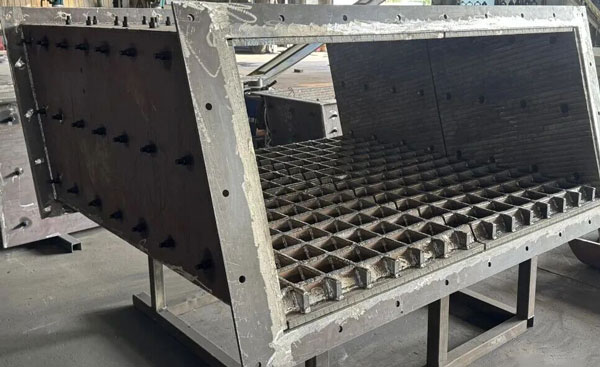
FNS custom underground ore unloading hopper for abrasive mining
2. Reinforced Housing + Modular Wear Liners
The second protection layer is the hopper structure itself.
FNS uses a reinforced, thickened frame to distribute the impact generated by falling ore across the structure rather than concentrating it at individual points.
The internal surfaces are fully protected with heavy-duty modular wear liners.
This modular design is particularly useful for mining maintenance. When a localized area becomes worn, the damaged liner can be replaced independently instead of discarding the entire hopper.
That means:
- Local replacement instead of complete replacement
- Shorter maintenance operations
- Lower spare-part consumption
- Better long-term maintenance economics
For an underground ore unloading hopper, modularity can be especially valuable where maintenance access is limited and downtime directly affects underground production.
3. Hardfacing on High-Wear Structural Edges
The third protection layer focuses on the hopper’s load-bearing vertical edges.
These areas can experience repeated impact, friction and stress concentration during ore unloading. FNS applies a wear-resistant hardfacing layer to critical vertical edges to improve their resistance to severe service conditions.
The hardfaced areas combine wear-resistant alloy protection with a tough welded structure.
The objective is not simply to make the surface harder. The hardfacing process is designed to provide a durable working layer while maintaining sufficient toughness under continuous impact.
This helps reduce the risk of premature cracking, peeling or excessive edge wear.
Three-Layer Protection for Mining Hoppers
The FNS design can be summarized as:
| Protection Layer | Main Function |
| Inclined grizzly | Retains ore and creates a material-on-material buffer |
| Reinforced housing + modular liners | Distributes impact and protects the internal structure |
| Hardfaced structural edges | Reinforces high-wear and high-stress areas |
Rather than depending on one wear-resistant material, the system uses different protection mechanisms at different locations.
This is particularly useful when the hopper must handle large quantities of abrasive ore under continuous impact conditions.
Designed for Practical Mine Maintenance
A mining hopper should not only survive harsh operating conditions; it should also be practical to maintain.
FNS customizes the hopper according to the application and can incorporate a standard flange structure compatible with commonly used underground ore unloading cars.
This helps simplify installation and replacement where the existing equipment interface is suitable.
The modular liner concept also means that maintenance teams can focus on the actual worn areas instead of replacing a complete hopper assembly.
For mine operators, this can translate into fewer unnecessary replacement costs and reduced maintenance downtime.
Where the FNS Hopper Fits
The underground ore unloading hopper is designed for applications involving heavy and abrasive bulk materials, including:
- Underground ore transfer
- Mining unloading systems
- Ore receiving points
- Underground haulage systems
- Abrasive mineral handling
- Ore transfer between mining equipment
The final hopper structure, liner arrangement and hardfacing specification should be selected according to ore characteristics, particle size, impact height, throughput and installation requirements.
Why Use a Custom Wear-Resistant Hopper?
A standard hopper may be sufficient for relatively mild service, but severe underground mining conditions can quickly expose weaknesses in conventional designs.
A customized FNS hopper focuses on the actual failure mechanisms:
Impact → abrasion → material accumulation → structural wear → maintenance
By introducing material-on-material buffering before the ore reaches the metal surface, then adding modular liners and hardfacing at critical locations, the design addresses several wear mechanisms simultaneously.
According to the supplied application data, the three-layer wear protection system can achieve a service life of approximately 2–3 times that of a conventional hopper. Actual service life will depend on ore properties, throughput, impact conditions and operating environment.
FNS — engineered wear protection for demanding mining equipment.
FAQ
1. How does the FNS hopper reduce impact wear?
The inclined grizzly retains ore between its wear-resistant ribs, creating a natural material buffer. Incoming ore impacts the retained ore rather than directly striking the metal structure.
2. Why is the grizzly installed at more than 45°?
The inclined arrangement helps retain material for cushioning while supporting the movement of both dry and wet ore. The exact angle can be adjusted according to the application.
3. Can the hopper liners be replaced individually?
Yes. The modular liner design allows worn sections to be replaced locally without replacing the complete hopper.
4. Where is hardfacing applied?
FNS applies wear-resistant hardfacing to high-wear structural areas, particularly critical vertical edges exposed to repeated impact and abrasion.
5. Is the hopper compatible with existing unloading cars?
The design can use a standard flange interface to suit commonly used unloading cars where dimensions and connection requirements are compatible.
6. How much longer can the hopper last?
Based on the supplied application data, the three-layer wear protection system can provide approximately 2–3 times the service life of a conventional hopper. Actual performance depends on operating conditions.


