



Amorphous Materials and Their Application in Laser Cladding Technology
Amorphous materials—also known as metallic glass—represent a class of solid metallic materials in which atoms lack long-range order. This unique amorphous structure gives rise to exceptional mechanical and chemical properties, including high strength, high hardness, excellent wear resistance, notable corrosion resistance, and desirable soft-magnetic behavior. As a result, amorphous alloys have become an important category of advanced materials widely used across industrial surface engineering and high-performance component manufacturing.
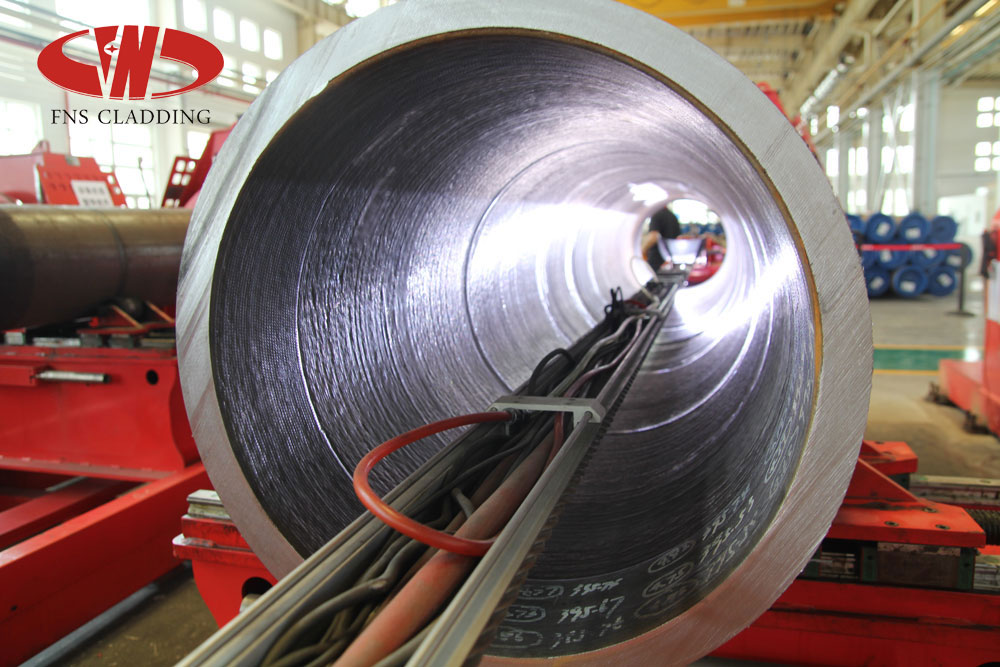
Weld overlay process in FNS Pipeline facility with automated systems
1. Characteristics of Amorphous Materials
The defining feature of amorphous alloys is their rapid solidification behavior, which results in a disordered atomic arrangement instead of the crystalline structures seen in traditional metals. This structural state delivers:
- Superior hardness and strength
- Outstanding resistance to wear and corrosion
- Good thermal stability in specific alloy systems
- High elastic limit and soft-magnetic performance
For industries operating under extreme conditions—such as pipeline systems, energy equipment, and heavy-duty mechanical components—these properties provide significant performance advantages.
2. Laser Cladding and Its Engineering Value
Laser cladding is a high-energy surface engineering technology that uses a focused laser beam to melt both the feedstock material and a thin layer of the substrate surface. The molten material solidifies rapidly to form a dense, metallurgically bonded coating. This process significantly improves:
- Wear resistance
- Corrosion resistance
- High-temperature oxidation resistance
- Fatigue performance
FNS Pipeline Technology applies laser cladding to strengthen critical components used in high-pressure, high-load, or corrosive service environments—common conditions in pipeline operations and industrial machinery.
3. Role of Amorphous Materials in Laser Cladding
In laser cladding, amorphous alloy powder can be added either as pre-placed powder or through synchronous powder feeding. Under laser irradiation, the powder melts instantly and then cools at extremely high rates—typically on the order of 10⁶ K/s.
This ultrafast cooling suppresses crystal nucleation and growth, making it possible to form:
- Amorphous phases
- Amorphous/nanocrystalline composite structures
Such coatings exhibit:
- Higher density and fewer defects
- Increased microstructural uniformity
- Improved wear resistance
- Enhanced corrosion resistance
- Reduced crack sensitivity
These characteristics make amorphous alloys for laser cladding a compelling choice for demanding industrial applications.
4. Advantages of High-Performance Amorphous Alloy Powders
Modern amorphous alloy powders are engineered specifically to optimize their behavior during laser cladding. Their benefits include:
- Excellent laser absorption, improving melting efficiency
- Good wettability, ensuring strong bonding with the substrate
- High glass-forming ability, supporting amorphous phase retention
- Stable cladding process, compatible with a wide range of metallic substrates
These powders allow FNS Pipeline Technology to deliver coatings with high bonding strength, low cracking tendency, and superior wear- and corrosion-resistant performance.
5. Industrial Applications
Amorphous materials and laser cladding technology have been successfully adopted in multiple high-value sectors, including energy, heavy machinery, and aerospace. Common applications include:
- Hydraulic cylinders
- Gears
- Bearings
- Turbine blades
- Critical components in pipeline systems
By applying laser-cladded amorphous coatings, service life is significantly extended and equipment reliability is improved—offering customers a cost-effective solution for both new manufacturing and remanufacturing projects.


