



Composition and Applications of Babbitt Alloy
Babbitt alloy, also known as Babbitt metal, is a low-melting, soft bearing alloy widely used as the working surface of sliding bearings. Composed primarily of tin, lead, antimony, and copper, this alloy is valued for its excellent embeddability, conformability, and anti-seizure properties—critical features that help protect shafts under high loads and low-speed operating conditions. For industries relying on stable, long-term equipment operation, Babbitt metal remains a trusted bearing lining material.
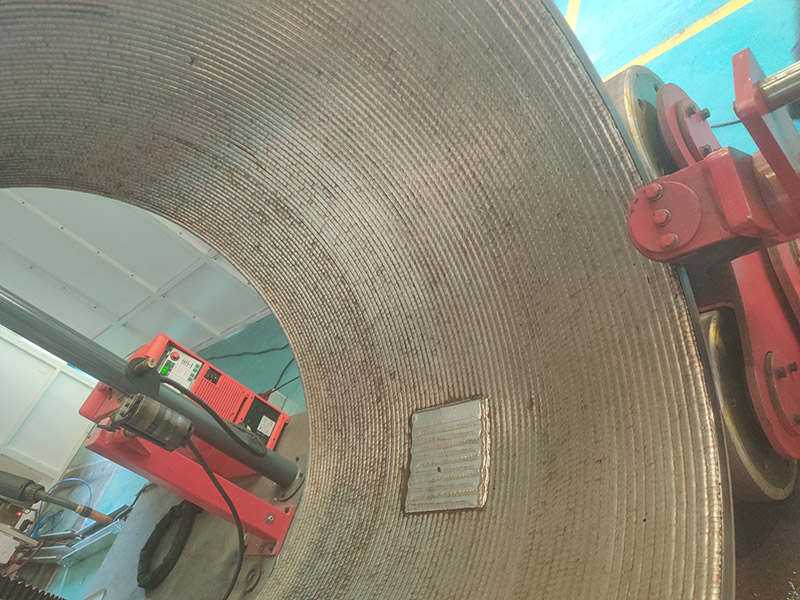
Large-diameter Oil ËlmBearing Surfacing with Babbitt Alloy
1. Classification of Babbitt Alloys
Depending on the primary base element, Babbitt alloys are generally divided into two categories:
Tin-Based Babbitt Alloy
Tin-based Babbitt alloys use tin (Sn) as the main matrix and typically contain:
- Antimony (Sb): 7–12%
- Copper (Cu): 2–5%
- Trace additions such as cadmium or arsenic (optional)
A common grade is SnSb11Cu6.
In this alloy, antimony and copper form hard intermetallic compounds—such as SbSn and Cu₆Sn₅—which are finely dispersed within a softer tin-rich matrix. This microstructure, characterized by soft matrix and hard particles, creates micro-oil pockets during operation, reduces friction, and provides reliable load-bearing performance.
Lead-Based Babbitt Alloy
Lead-based Babbitt alloys use lead (Pb) as the primary matrix and usually include:
- Antimony (Sb): 10–15%
- Tin (Sn): 5–10%
A typical grade is PbSb15Sn10.
This alloy offers a more economical option, suitable for medium-load applications. The Sn-Sb intermetallic compound strengthens the alloy, while the lead matrix supplies good ductility and shock resistance.
2. Selecting the Right Babbitt Alloy
When selecting a Babbitt bearing material, engineers must consider load, operating speed, temperature, corrosion environment, and budget:
- Tin-based Babbitt alloy
- Higher strength
- Better corrosion resistance
- Suitable for critical equipment and demanding service conditions
- Lead-based Babbitt alloy
- Lower cost
- Adequate for general industrial machinery and medium loads
As a supplier supporting the pipeline and heavy-equipment industries, FNS Pipeline Technology Co., Ltd. frequently works with customers to recommend the optimal alloy formulation based on operating requirements.
3. Applications in Sliding Bearings
In practical manufacturing, Babbitt alloy is often cast or bonded as a thin inner layer on the bearing shell. This creates a stable tribological system that provides:
- Protection against metal-to-metal contact
- Improved lubrication behavior
- Reduced wear under fluctuating loads
- Extended service life of shafts and rotating components
Quality of performance depends heavily on precise composition control and reliable melting and casting procedures. Consistent microstructure is essential to ensuring long-term bearing reliability, especially in high-value industrial equipment.


