


Optical Lens Requirements Inside a Laser Cladding Head
Laser cladding is a high-energy manufacturing process in which alloy powders are melted by a concentrated laser beam to form metallurgically bonded coatings or 3D structures on a substrate. In any industrial laser cladding system, the stability and accuracy of material deposition rely strongly on the performance of the laser cladding optical lens. As one of the most critical components inside the cladding head, the lens must deliver precise energy concentration while withstanding heat, metal vapor, powder impact, and long-term thermal cycling. At FNS Pipeline Technology Co., Ltd., we work closely with clients to ensure that the optical elements used in laser cladding heads meet strict performance, durability, and safety requirements.
1. High Power Endurance: The Fundamental Requirement
Industrial laser cladding typically operates with multi-kilowatt or even tens-of-kilowatts laser power. The optical lens must withstand extremely high energy density for long durations.
Any minor absorption can trigger thermal accumulation, leading to:
- thermal lensing (change of refractive index with heat)
- focus drift and beam distortion
- uneven cladding layers
- cracking or catastrophic lens failure
Reliable high-power optical lenses are therefore essential to ensure continuous, stable laser output in FNS laser cladding systems.
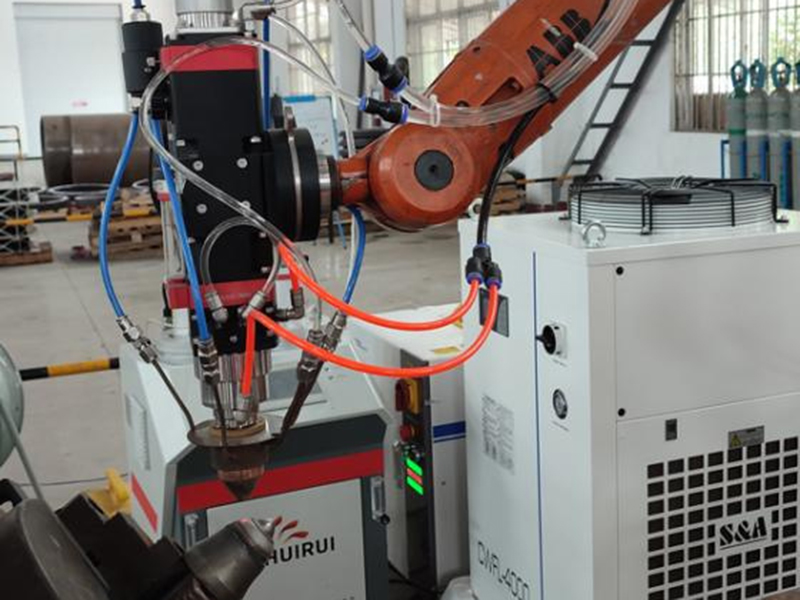
Laser Cladding Machine in FNS pipeline
2. Superior Optical Transmission and Low Absorption
To maintain high process efficiency, lenses must achieve:
- laser transmission > 99.5%
- extremely low absorption in both lens material and coating
Energy absorbed by the lens converts directly into heat, accelerating:
- thermal lensing
- coating degradation
- performance instability
- premature lens aging
High-purity substrates and precision multi-layer coatings are crucial for maintaining consistent results in high-power laser cladding applications.
3. High Laser-Induced Damage Threshold (LIDT)
A high LIDT optical lens is vital for long-term reliability.
Both the anti-reflective coating and substrate must endure:
- intense instantaneous laser pulses
- sustained thermal load
- repeated thermal cycling
If the coating is damaged—even slightly—transmission drops rapidly, creating a self-amplifying heat-accumulation effect that can cause full system failure. FNS therefore selects optical components with exceptionally high LIDT values to support stable industrial operation.
4. Excellent Thermal Stability Under Extreme Conditions
Materials with minimal thermal expansion ensure that lenses maintain their geometry and focal accuracy during operation. Poor thermal stability may result in:
- optical path deviation
- focus shift
- dimensional distortion
- inconsistent melt pool behavior
FNS integrates thermally stable optical lenses to ensure repeatable precision during long, continuous cladding operations.
5. Mechanical Strength and Installation Stability
Industrial environments expose laser cladding heads to vibrations, shocks, and assembly stresses. The optical lens must have:
- sufficient mechanical strength
- rigid mounting
- stable alignment over prolonged use
This mechanical robustness is essential to keep the optical axis unchanged and maintain coating uniformity during high-demand operations across pipeline repair, heavy equipment refurbishment, and additive manufacturing tasks.
6. Anti-Contamination Capability and Easy-Maintenance Design
During cladding, metal vapor, powder particles, and fumes pose significant contamination risks—especially for the protective lens at the head’s front section. An effective optical system must feature:
- anti-static or anti-smudge coatings
- high-durability protective lenses
- easy-to-replace modular structures
If contamination is not addressed promptly, localized heating may cause rapid lens failure. FNS designs their laser cladding optical systems with convenient maintenance in mind, reducing downtime and operational cost for users.
A high-performance laser cladding optical lens is fundamental to achieving stable, accurate, and durable cladding results. By selecting heat-resistant materials, maintaining optical purity, optimizing protective design, and ensuring reliable cooling, operators can significantly enhance the service life of their equipment and the quality of each cladded layer. FNS Pipeline Technology Co., Ltd. is committed to delivering industrial solutions that integrate advanced optical protection and consistent performance for demanding cladding applications.


