



Nickel-Based Alloy Hardfacing Welding: Best Practices, Common Challenges, and Process Guide
Nickel-Based Alloy Hardfacing Welding has become one of the most reliable surface engineering technologies for equipment operating in corrosive, high-temperature, and severe wear environments. From oil & gas valves and chemical processing equipment to pipeline components, mining machinery, and power generation systems, Nickel-Based Alloy Hardfacing Welding creates a dense metallurgical bonding layer that dramatically improves corrosion resistance, wear resistance, and service life without replacing the entire component.
At FNS Pipeline Technology Co., Ltd., we provide advanced Nickel-Based Alloy Hardfacing Welding solutions using GTAW, PTA, laser cladding, and automated hardfacing systems. Our engineers optimize welding procedures according to alloy composition, substrate material, service environment, and dimensional requirements to ensure long-term reliability.
Why Choose Nickel-Based Alloy Hardfacing?
Nickel-based alloys combine outstanding corrosion resistance with excellent mechanical properties. Unlike conventional hardfacing materials, nickel alloys remain stable in aggressive media including:
- Chloride-containing environments
- Acidic chemicals
- Sour gas (H₂S)
- CO₂ corrosion
- High-temperature oxidation
- Marine atmospheres
Instead of manufacturing an entire component from expensive nickel alloy, many industries choose to hardface carbon steel or stainless steel substrates. This approach combines:
- Structural strength from the base material
- Superior corrosion resistance from the nickel alloy overlay
- Lower manufacturing costs
- Longer equipment life
- Easier repair and remanufacturing
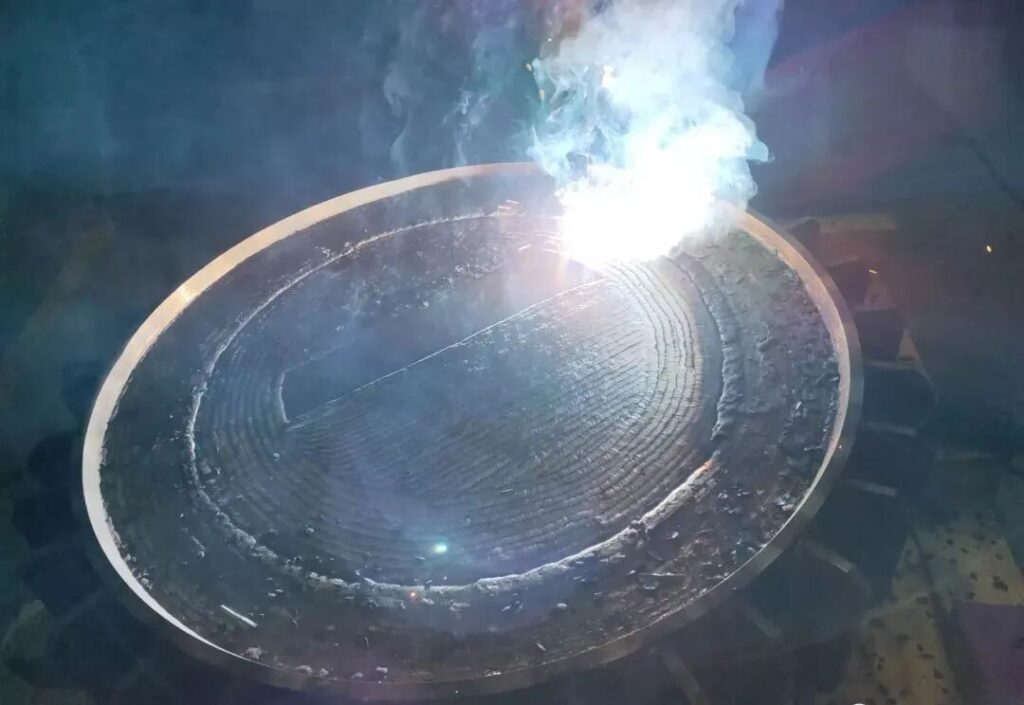
Automated nickel alloy overlay welding by FNS Pipeline Technology
Why Nickel-Based Alloy Welding Is Different
Although nickel alloys are highly versatile, they require welding techniques that differ significantly from carbon steel or stainless steel.
The biggest difference is the behavior of the molten weld pool.
Nickel-based molten metal is:
- Highly viscous
- Less fluid
- Shallower in penetration
- More susceptible to hot cracking
- More sensitive to heat input
Because of these characteristics, simply increasing welding current rarely improves penetration. Instead, excessive heat often causes grain coarsening, porosity, and solidification cracking.
Successful Nickel-Based Alloy Hardfacing Welding relies on process control rather than higher heat input.
Common Nickel-Based Hardfacing Materials
FNS commonly applies the following alloys according to customer requirements.
| Alloy | Main Features | Typical Applications |
| Inconel 625 | Excellent corrosion resistance | Pipelines, valves, pressure vessels |
| Inconel 686 | Strong resistance to aggressive acids | Chemical plants |
| Hastelloy C276 | Outstanding pitting resistance | Offshore equipment |
| Nickel 60 Alloy | High hardness and wear resistance | Screw barrels, mining parts |
| Ni-WC Composite | Extreme abrasion resistance | Drilling tools, crusher components |
Key Welding Challenges
1. High Molten Pool Viscosity
Nickel alloys do not spread like stainless steel.
Instead of forming a wide concave bead, the weld typically produces a convex profile.
Attempting to flatten the bead by increasing current usually creates defects rather than improving weld quality.
2. Hot Cracking Sensitivity
The first layer is especially susceptible to crystallization cracking.
To minimize this risk, FNS recommends:
- Small welding current
- Multiple passes
- Controlled bead width
- Uniform heat distribution
- Stable shielding gas protection
3. Low Penetration
Nickel alloy naturally produces shallow fusion.
Rather than increasing current, experienced welding engineers typically improve penetration through:
- Proper groove preparation
- Correct torch angle
- Multi-layer deposition
- Optimized travel speed
In many industrial applications, groove angles between 40° and 65° provide better fusion while reducing residual stress.
Recommended GTAW Hardfacing Techniques
During GTAW hardfacing, filler wire handling is extremely important.
Best practices include:
- Keep the filler wire ahead of the tungsten electrode.
- Never dip the wire directly into the weld pool.
- Keep the wire tip continuously protected by argon.
- Maintain a short arc length.
- Use steady travel speed.
- Minimize weaving.
These practices reduce oxidation and produce smoother weld beads.
Why Convex Weld Beads Are Preferred
Many welders accustomed to stainless steel attempt to create flat or concave weld beads.
For nickel alloys, this is a mistake.
A slightly convex bead provides:
- Better stress distribution
- Lower crack sensitivity
- Improved metallurgical stability
- Higher fatigue resistance
Field investigations show that many nickel alloy weld cracks originate from improperly formed concave weld beads.
Heat Input Control
One of the most important principles in Nickel-Based Alloy Hardfacing Welding is limiting heat input.
Recommended practices include:
- Low welding current
- Low heat input
- Interpass temperature below 100°C
- No unnecessary preheating
- Avoid excessive weaving
Unlike carbon steel, nickel alloys generally do not require post-weld heat treatment, unless specified by project requirements.
Groove Design Matters More Than Welding Current
Many welders assume that increasing amperage solves shallow penetration.
Extensive industrial testing proves otherwise.
Optimizing groove geometry usually provides better fusion than increasing heat.
A modified groove angle:
- Improves root fusion
- Reduces lack-of-fusion defects
- Lowers residual stress
- Produces more uniform hardfacing layers
This approach is widely adopted in pressure vessel and corrosion-resistant overlay projects.
Common Welding Defects and Prevention
| Defect | Primary Cause | Prevention |
| Hot cracking | Excessive heat input | Low current, multiple passes |
| Porosity | Poor shielding | Stable argon protection |
| Lack of fusion | Incorrect groove | Optimize groove geometry |
| Undercut | Excessive travel speed | Short arc, controlled weaving |
| Oxidation | Inadequate shielding | Full argon coverage |
| Distortion | Excessive heat | Controlled interpass temperature |
Industrial Applications
FNS Pipeline Technology Co., Ltd. performs Nickel-Based Alloy Hardfacing Welding for numerous industries, including:
- Oil & gas pipelines
- Valve sealing surfaces
- Pressure vessel nozzles
- Pipe end CRA cladding
- Chemical processing equipment
- Offshore components
- Mining equipment
- Plastic extrusion screws
- Pump shafts
- Hydraulic cylinders
- Power generation equipment
- Heat exchangers
FNS Project Example
Inconel 625 Hardfacing for Pipeline Valve Components
A pipeline customer required corrosion-resistant valve sealing surfaces for chloride-containing service.
Instead of manufacturing the complete valve from nickel alloy, FNS applied automated Inconel 625 hardfacing to stainless steel sealing areas using precision GTAW.
Project results included:
- Uniform metallurgical bonding
- No visible cracks or porosity after PT inspection
- Stable weld bead geometry
- Improved corrosion resistance
- Significant reduction in material costs compared with solid nickel alloy components
The project demonstrated how engineered hardfacing delivers premium performance while reducing overall manufacturing costs.
Why Manufacturers Choose FNS Pipeline Technology Co., Ltd.
FNS combines welding expertise with automated surface engineering technologies to provide consistent hardfacing quality.
Our capabilities include:
- PTA hardfacing
- Laser cladding
- GTAW overlay welding
- Internal bore cladding
- Double-torch automated pipe cladding
- Valve hardfacing
- Nickel alloy overlay
- Tungsten carbide hardfacing
- Automated remanufacturing systems
- Complete NDT and quality inspection
Every project is developed according to customer material specifications, corrosion environment, and expected service life.
Frequently Asked Questions
What is Nickel-Based Alloy Hardfacing Welding?
It is a surface enhancement process that deposits a corrosion-resistant nickel alloy onto steel components through metallurgical bonding, improving wear resistance, corrosion resistance, and service life.
Why is nickel alloy harder to weld than stainless steel?
Nickel alloys have lower fluidity, higher viscosity, and greater susceptibility to hot cracking. They require tighter control of heat input, shielding gas, and welding parameters.
Should welding current be increased to improve penetration?
No. Higher current often causes overheating, grain coarsening, porosity, and cracking. Proper groove design and multi-pass welding are generally more effective.
Why is a convex weld bead recommended?
A convex bead distributes welding stress more evenly and reduces the likelihood of solidification cracking, making it the preferred profile for nickel alloy overlays.
Is preheating required?
Most nickel-based alloys do not require preheating. However, specific substrate materials or thick sections may require controlled preheating based on the WPS.
What interpass temperature is recommended?
For most nickel alloy hardfacing projects, the interpass temperature should remain below 100°C to minimize thermal stress and preserve corrosion resistance.
Which industries benefit most from nickel alloy hardfacing?
Oil and gas, offshore engineering, petrochemical processing, mining, power generation, pipeline manufacturing, valves, pumps, and pressure vessels all benefit from nickel alloy overlays.
Can nickel alloy hardfacing repair worn equipment?
Yes. Hardfacing is widely used for remanufacturing worn components by restoring dimensions while simultaneously improving wear and corrosion performance beyond the original condition.


