



Plasma Transferred Arc Welding (PTA) Principle and Advantages for Valve Hardfacing
In demanding pipeline, petrochemical, and energy applications, valves are exposed to high pressure, corrosion, erosion, and repeated mechanical wear. To extend service life and reduce maintenance costs, FNS Pipeline Technology Co., Ltd. applies advanced plasma transferred arc welding (PTA welding) technology to valve sealing surfaces and critical wear zones.
Plasma welding offers a highly controllable and efficient hardfacing solution, particularly suitable for high-alloy and composite materials that cannot be easily processed using conventional welding methods.
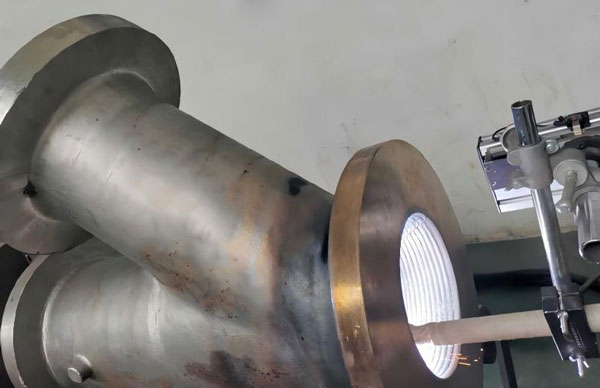
Plasma transferred arc welding process for valve hardfacing
Principle of PTA Welding
Plasma transferred arc welding is a surface alloy deposition process that uses an argon plasma arc as a high-energy heat source and alloy powder as the filler material. The process is widely used for valve hardfacing, repair, and surface strengthening.
During PTA welding, a plasma torch (also called a plasma arc generator) ionizes the shielding gas to form an electric arc between the cathode and a water-cooled copper nozzle, or between the cathode and the workpiece. The arc is forced through a narrow nozzle orifice, where it is strongly compressed by the surrounding cold gas.
This compression creates a plasma arc characterized by:
- Thermal constriction
- Mechanical compression
- Self-magnetic compression
As a result, the arc column diameter becomes significantly smaller, increasing current density and gas ionization. Compared with a conventional free arc, the plasma arc achieves higher temperature, concentrated energy, excellent stability, and precise controllability.
Plasma arcs are classified into non-transferred arcs (between the cathode and the nozzle) and transferred arcs (between the cathode and the workpiece). In plasma welding and hardfacing, the transferred plasma arc serves as the primary heat source, ensuring strong metallurgical bonding between the coating and the base material.
Key Features of Plasma Welding Hardfacing
By combining a concentrated plasma heat source with self-fluxing alloy powders, plasma welding offers distinct advantages over traditional hardfacing processes.
1. Suitable for high-alloy and composite materials
Plasma welding is ideal for materials that are easy to produce in powder form but difficult or impossible to manufacture as welding wire, including cobalt-based, nickel-based, and complex composite alloys.
2. Low dilution and precise melt depth control
The alloy powder and molten pool act as a buffer to the plasma arc, allowing precise control of penetration depth and maintaining a low dilution rate. This ensures that the deposited layer retains its designed chemical composition.
3. Uniform hardness and microstructure
The hardfacing layer produced by PTA welding exhibits consistent hardness and homogeneous microstructure, reducing the risk of cracks, porosity, or segregation defects.
4. Smooth weld bead and flexible deposition range
Plasma welding produces smooth, well-shaped weld beads with a wide adjustable range for layer thickness and deposition rate, making it suitable for both small precision components and large industrial valves.
5. Micro-plasma capability for precision hardfacing
Using fine alloy powders and low-current micro-plasma arcs, PTA welding can achieve high-precision hardfacing on sealing surfaces, edges, and narrow wear zones.
6. Continuous process and easy automation
Plasma welding supports continuous operation and is well-suited for automated or CNC-controlled systems, ensuring stable quality and high production efficiency.
FNS Plasma Welding Solutions for Valves
At FNS Pipeline Technology Co., Ltd., PTA welding is widely applied to gate valves, ball valves, check valves, and control valves used in pipeline and petrochemical systems. By selecting optimized alloy powders and process parameters, FNS delivers valve hardfacing solutions with:
- Excellent wear and corrosion resistance
- Strong metallurgical bonding
- Extended service life and reduced downtime
- Lower total cost of ownership
Our plasma welding expertise enables customers to achieve reliable valve performance even under extreme operating conditions.


