



Advanced Forms of Plasma Arc Welding and Their Industrial Applications
Plasma Arc Welding (PAW) has evolved into several advanced process variants to meet the increasing demands of precision, productivity, and material performance. Building on conventional PAW technology, these improved forms offer greater control, deeper penetration, and broader application ranges. At FNS Pipeline Technology Co., Ltd., we apply these advanced plasma arc welding solutions to serve industries such as energy, aerospace, petrochemical, and precision manufacturing.
Key Improved Forms of Plasma Arc Welding
Pulsed Plasma Arc Welding
Plasma arc welding can operate with pulsed current, offering advantages similar to pulsed GTAW. The peak current increases penetration, while the base current allows the weld pool to solidify and cool the tungsten electrode and nozzle.
This approach stabilizes the molten pool and is well suited for out-of-position welding. Standard pulsed GTAW control systems can be used, making it practical and flexible for industrial production.
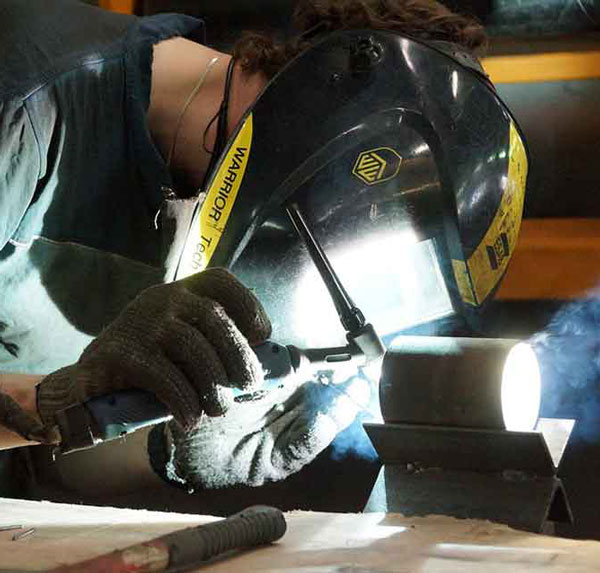
Plasma transferred arc welding coating with metallurgical bonding
Program-Controlled Manual Plasma Arc Welding
Program-controlled PAW uses a programmable power source to handle complex welding tasks. Depending on the application, both welding current and plasma gas flow can be precisely programmed.
Gas flow programming is particularly beneficial for maintaining stable keyhole closure, making this method ideal for pipe root pass welding, where controlled penetration and bead integrity are critical—an area where FNS has extensive field experience.
Hot Wire Plasma Arc Welding
Similar to GTAW, PAW can use either cold wire or hot wire feeding. Hot wire plasma arc welding improves deposition efficiency and is widely used for pipeline welding and surface cladding, especially when higher productivity and consistent bead geometry are required.
Micro Plasma Arc Welding
Micro plasma arc welding operates at very low current levels and is designed for ultra-thin materials and precision components. Welding currents around 110 A or lower require high-precision travel systems and fixtures.
This process is commonly applied in medical devices, instrumentation, and micro-mechanical components, where FNS provides customized automation solutions.
Automatic Plasma Arc Welding
Automatic PAW systems are extensively used in aerospace, jet engine manufacturing, and high-precision equipment production. With excellent arc stability and repeatability, automated plasma arc welding ensures consistent quality for critical components.
Variable Polarity Plasma Arc Welding (VPPA)
Variable Polarity Plasma Arc Welding (VPPA) is an advanced process developed primarily for aerospace applications. It is especially suitable for welding thick aluminum alloys, such as those used in spacecraft fuel tanks.
By shortening the duration of the positive polarity half-cycle and extending the reverse polarity half-cycle, VPPA enhances cathodic cleaning while maintaining sufficient heat input. This waveform control requires specialized power supplies and produces a stable keyhole effect.
Notably, the external fuel tanks of U.S. space shuttle programs were welded using VPPA technology.
Plasma Arc Spray Welding (PTA)
Plasma Transferred Arc (PTA) spray welding is a thermal spray welding process that differs from plasma spraying in that the deposited metal forms a true metallurgical bond with the substrate.
PTA produces dense, slag-free coatings with nearly 100% density and low dilution, often achieved in a single layer. Since most PTA materials are high-hardness alloys that cannot be drawn into wire, powder feedstock is commonly used.
PTA spray welding is widely applied for wear-resistant surface coatings. Coating thickness and shape are easy to control, with single-pass layers typically ranging from 1.25 to 4.75 mm. For high-precision assemblies, post-weld grinding ensures dimensional accuracy.
FNS Expertise in Advanced Plasma Welding Solutions
With deep expertise in plasma arc welding technologies, FNS Pipeline Technology Co., Ltd. provides tailored solutions that balance weld quality, productivity, and cost efficiency. From precision micro-welding to heavy-duty PTA hardfacing, our engineering team supports customers throughout process selection, parameter optimization, and production implementation.


