


Plasma Welding: Enhancing Wear Resistance of PDC Drill Bits
In modern oil and gas exploration, drilling efficiency depends heavily on the durability and performance of the drill bit. PDC (polycrystalline diamond compact) drill bits are widely used thanks to their high cutting speed, stability, and long lifespan. However, when operating in harsh subsurface environments—characterized by high temperature, high pressure, and highly abrasive formations—PDC bits inevitably face intense wear.
To overcome these challenges, plasma welding, also known as plasma transferred arc (PTA) hardfacing, has become a preferred solution. As a leading provider of surface-enhancement and repair technologies, FNS Pipeline Technology Co., Ltd. delivers advanced plasma welding services tailored for oilfield drilling tools, helping customers reduce downtime and achieve higher operational efficiency.
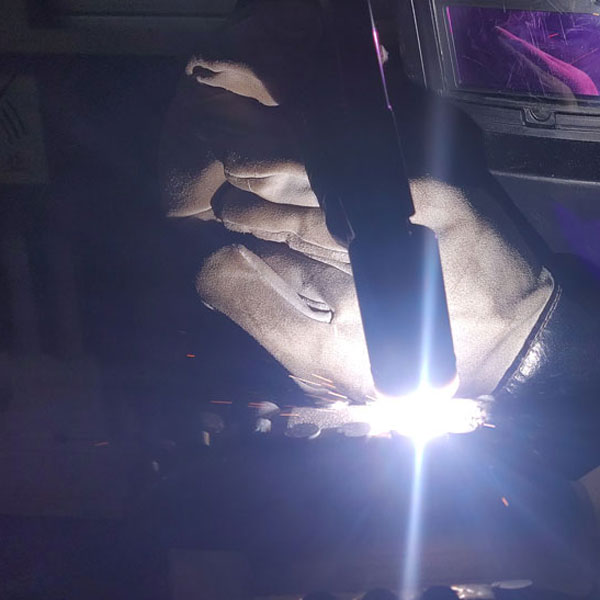
Plasma welding hardfacing applied to a PDC drill bit for improved wear resistance
Wear Challenges of PDC Drill Bits
During drilling operations, PDC bits rotate thousands of times per minute while continuously cutting into hard rock formations. Under such extreme mechanical and thermal loads, the steel body of the drill bit can suffer:
- Abrasive wear
- Erosion
- Impact damage
- Thermal fatigue
Left untreated, the worn areas compromise drilling efficiency, increase operating costs, and shorten the working life of the drill bit.
What Is Plasma Welding (PTA Hardfacing)?
Plasma welding is a high-precision welding and coating process that uses a constricted plasma arc to melt and deposit wear-resistant alloy powders onto the surface of the drill bit. The resulting metallurgically bonded layer forms a dense, extremely hard, and uniform protective coating.
For PDC drill bits, this coating dramatically improves resistance to abrasive wear and heat, ensuring more stable drilling performance in demanding geological conditions.
Key Advantages of Plasma Welding for PDC Drill Bits
1. Outstanding Wear Resistance
PTA hardfacing forms a dense, high-hardness alloy layer capable of withstanding long-term abrasion from rock fragments and drilling debris.
2. Superior High-Temperature Performance
The alloy coating maintains its hardness and structural integrity even under continuous high-temperature exposure, preventing thermal degradation of the drill bit.
3. Extended Service Life & Reduced Downtime
With improved durability, drill bits require fewer replacements, reducing non-productive time (NPT) and enhancing drilling efficiency.
4. Cost-Effective Maintenance Solution
Compared with purchasing new drill bits, plasma welding repair offers significant cost savings while restoring performance to near-new levels.
FNS Pipeline Technology: Your Partner for PTA Hardfacing Solutions
FNS combines advanced plasma transferred arc systems with strict quality control to ensure:
- Precision alloy deposition
- Uniform coating thickness
- Excellent metallurgical bonding
- Minimal base-material dilution
- Consistent wear performance in field applications
Our PTA hardfacing services are widely used for:
- PDC drill bits
- Stabilizers
- Reamers
- Wear-resistant oilfield components
By delivering reliable surface-enhancement technology, FNS helps customers maximize the value of every drilling tool and achieve better economic returns in exploration projects.
Plasma welding is a proven, high-performance method for improving the wear resistance and lifecycle of PDC drill bits. Through advanced PTA hardfacing services, FNS Pipeline Technology Co., Ltd. provides durable, cost-effective solutions that enhance drilling efficiency and support long-term operational success in the oil and gas industry.


