


How Hardfacing Remanufacturing Reduces Equipment Replacement Costs: A Complete Guide for Industrial Asset Managers
Industrial companies are under constant pressure to lower maintenance expenses while maximizing equipment availability. One of the most effective strategies is understanding how hardfacing remanufacturing reduces equipment replacement costs. Instead of discarding worn components and purchasing expensive new parts, manufacturers can restore critical equipment through advanced surface engineering technologies such as plasma cladding, laser cladding, and alloy hardfacing.
At FNS Pipeline Technology Co., Ltd., we have helped customers in mining, oil & gas, steel production, power generation, cement, and heavy machinery industries restore high-value components that would otherwise require costly replacement. In many applications, hardfacing remanufacturing reduces equipment replacement costs by more than 60% while significantly extending service life.
Why Equipment Replacement Is So Expensive
Replacing industrial components involves much more than the purchase price.
Typical replacement expenses include:
- New component manufacturing
- Transportation and logistics
- Customs duties (for imported parts)
- Inventory costs
- Equipment shutdown
- Installation labor
- Commissioning
- Lost production
- For large mining or oil & gas equipment, the indirect costs often exceed the price of the component itself.
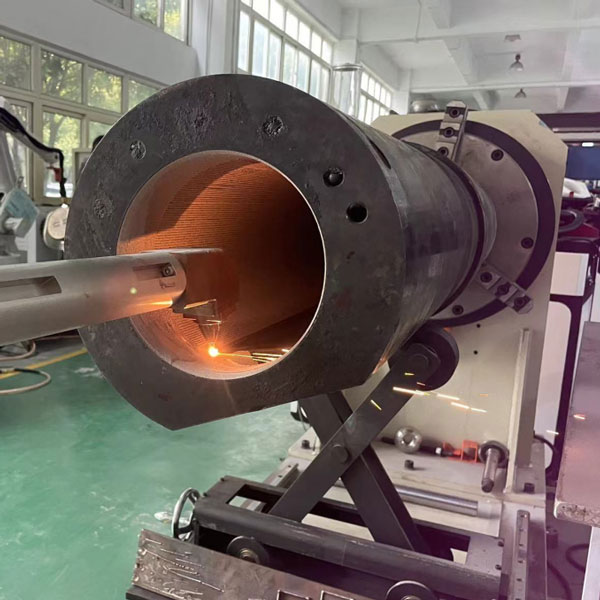
Laser cladding repair for die casting machine barrel surface restoration
Hidden Costs of Equipment Downtime
Unexpected downtime is one of the biggest financial risks in industrial operations.
Every hour of equipment shutdown may result in:
- Lost production output
- Missed delivery schedules
- Emergency maintenance expenses
- Overtime labor
- Reduced plant utilization
Restoring an existing component through hardfacing often minimizes these hidden costs because repair lead times are significantly shorter than ordering a new replacement.
How Hardfacing Remanufacturing Works
Hardfacing remanufacturing restores worn surfaces by depositing wear-resistant alloys onto damaged areas.
Common technologies include:
Plasma Cladding
- Low dilution
- High precision
- Excellent metallurgical bonding
Laser Cladding
- Minimal heat distortion
- Fine microstructure
- High dimensional accuracy
Traditional Hardfacing
- Cost-effective for large components
- Suitable for heavy material buildup
After restoration, the component is machined, inspected, and returned to service with enhanced wear resistance.
Repair vs Replacement: Cost Comparison
The following example illustrates the economic advantage of remanufacturing.
| Item | Purchase New | Hardfacing Remanufacturing |
| Component Cost | $18,000 | — |
| Repair Cost | — | $5,200 |
| Downtime | 12 Days | 4 Days |
| Installation Cost | High | Low |
| Service Life | 100% | 85–120%* |
| Total Lifecycle Cost | High | Significantly Lower |
*Depending on alloy selection and operating conditions, remanufactured components can equal or exceed the performance of new parts.
ROI Analysis
Assume a mining company replaces four scraper conveyor troughs every year.
Traditional Replacement
- Four new components: $72,000
- Installation and logistics: $12,000
- Total annual cost: $84,000
Hardfacing Remanufacturing
- Four repairs: $20,800
- Installation: $6,000
- Total annual cost: $26,800
Annual Savings
More than $57,000
In addition to direct savings, the company benefits from reduced downtime and improved equipment availability.
Components Suitable for Hardfacing Remanufacturing
Hardfacing is ideal for components exposed to wear, corrosion, erosion, or high temperatures.
Typical examples include:
Mining Industry
- Conveyor troughs
- Crusher hammers
- TBM cutter rings
- Cutting picks
- Wear plates
Oil & Gas
- Valve seats
- Pipeline components
- Pump sleeves
- Drill tools
- Pipe end cladding
Steel Industry
- Roll journals
- Guide rollers
- Bearing housings
- Furnace components
Plastic Machinery
- Extruder screws
- Barrels
- Feed sleeves
Power Generation
- Turbine shafts
- Hydraulic cylinders
- Boiler components
Why Hardfacing Often Outperforms New Components
Modern hardfacing alloys are engineered to exceed the wear performance of many original materials.
Benefits include:
- Higher hardness
- Better corrosion resistance
- Improved heat resistance
- Enhanced abrasion resistance
- Longer maintenance intervals
Rather than simply restoring dimensions, hardfacing upgrades surface performance.
FNS Engineering Case Study
Conveyor Trough Remanufacturing for a Coal Mine
A coal mining customer was replacing scraper conveyor trough sections every eight months because of severe abrasive wear.
Challenge
- High replacement costs
- Frequent production interruptions
- Long procurement lead times
FNS Solution
FNS applied automated plasma cladding with a tungsten carbide reinforced alloy.
The project included:
- Surface preparation
- Automated cladding
- Stress control
- Precision machining
- Non-destructive inspection
Results
- Service life increased by more than 2.2 times
- Annual replacement costs reduced by approximately 65%
- Downtime significantly shortened
- Wear resistance greatly improved
Following the successful trial, the customer expanded the remanufacturing program to additional conveyor components.
Why Manufacturers Are Choosing Remanufacturing
Industrial companies increasingly prioritize remanufacturing because it delivers:
- Lower capital expenditure
- Reduced maintenance budgets
- Shorter lead times
- Improved sustainability
- Lower carbon emissions
- Better asset utilization
Instead of replacing valuable components, manufacturers can maximize the return on existing assets.
Why Choose FNS Pipeline Technology Co., Ltd.?
FNS provides complete hardfacing and remanufacturing solutions, including:
- Plasma transferred arc (PTA) cladding
- Laser cladding
- Internal bore cladding
- CRA pipe end cladding
- Wear-resistant alloy powder development
- Automated hardfacing systems
- Precision machining and inspection
Our engineering team works closely with customers to determine whether repair or replacement offers the greatest long-term value.
Related Articles
Continue exploring our hardfacing knowledge center:
- Hardfacing Remanufacturing Process: A Complete Guide to Industrial Component Restoration
- Plasma Cladding Process vs Traditional Hardfacing: Which Repair Method Delivers Better Performance?
- Laser Cladding vs Plasma Cladding: Complete Comparison
- Internal Bore Cladding for Industrial Components
Frequently Asked Questions
Is hardfacing remanufacturing cheaper than buying new equipment?
In most cases, yes. Remanufacturing typically costs 30–60% of the price of a new component while delivering comparable or improved performance.
Can remanufactured components last as long as new ones?
Yes. With the correct alloy and process, many remanufactured parts achieve service lives equal to or longer than original components.
Which industries benefit the most?
Mining, oil & gas, steel, power generation, cement, plastics processing, chemical processing, and heavy manufacturing all benefit from hardfacing remanufacturing.
What components should not be remanufactured?
Components with severe structural damage, extensive cracking, or failure beyond repair limits may require replacement. An engineering assessment is recommended.
How much downtime can remanufacturing save?
Repair lead times are often reduced by 40–70% compared with manufacturing and shipping new components, minimizing production interruptions.
Does hardfacing improve the original component?
Yes. Advanced nickel-based, cobalt-based, or tungsten carbide alloys can significantly improve wear, corrosion, and heat resistance beyond the original material.
How does FNS determine the best repair solution?
Our engineers evaluate the wear mechanism, base material, operating environment, and expected service life before recommending the most suitable cladding technology and alloy.
Is hardfacing environmentally friendly?
Yes. By extending the life of existing components, remanufacturing reduces raw material consumption, manufacturing energy, transportation emissions, and industrial waste.


